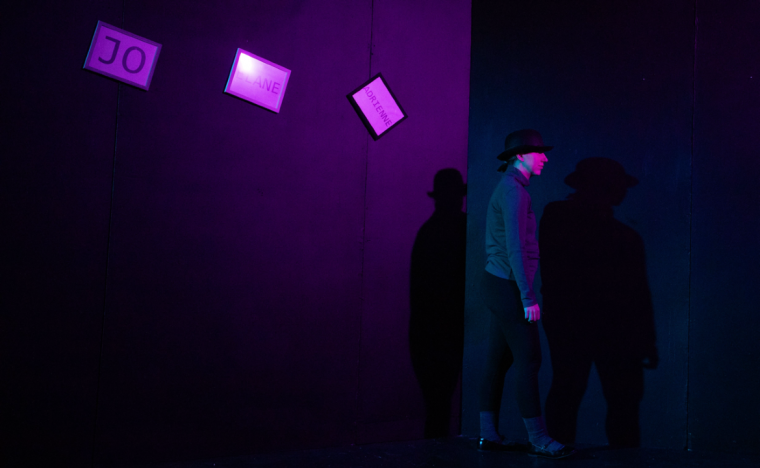
Jo Vasquez in What Might Have Been
What a night of theatre Thursday night’s What Might Have Been opening proved to be. Three compact one-acts, each with its own cast, its own director, and its own distinct tone, all presented under the umbrella of Barely There Theatre head, playwright, and fellow Reader reviewer Alexander Richardson. And while I don’t typically write by following a production's strict chronological order, after staring at a blank screen for far longer than necessary, I cannot think of a more effective way to capture the experience. This was a night best understood as it unfolded.
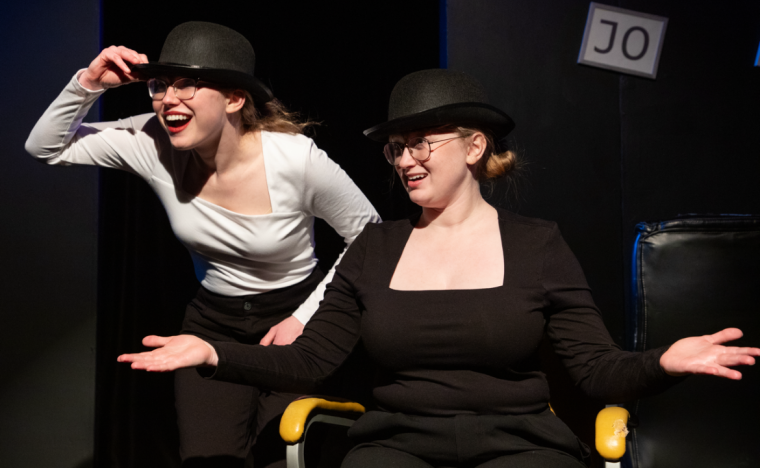
Thursday's evening opened with director Sydney Richardson's Narrator Needed, a piece built around an immediately engaging and playful premise. Members of the cast enter and solicit a volunteer from the audience, who is whisked onto the stage and handed a laptop from which they narrate the story in real time. After a brief instructional period, the production delivers one of its most delightful visual tricks: a bowler hat drops from above, instantly costuming the narrator to match the ensemble.
The costuming underscores the show’s fondness for deliberate confusion. And the confusion continued through the names: Adrienne Evans plays a character named Elane, while Elane Edwards' character name is Adrienne. Jo Vasquez’s character is simply named Jo. All three are dressed in neutral tones and identical hats, creating a uniformity that emphasizes the monotony at the story's heart.
Narrator Needed reminded me much of the Will Ferrell film Stranger Than Fiction. Jo is the central character, working in a cubicle alongside Adrienne and Elane, quietly angling for a promotion with an absurdly elaborate title that earned a smile from me, and giggles from others, every time it was uttered. Jo’s daily actions are narrated aloud by the figure she encounters near the end of the play, blurring the line between lived experience and authored existence.
The production was gifted a few unexpected twists by circumstance. Evans appeared in a walking boot, resulting in Edwards pushing her around the stage in a wheeled office chair, a staging adjustment that added charm and physical comedy. Vasquez, meanwhile, was battling laryngitis, and her raspy voice lent an un-manufacturable vulnerability to her character. These unplanned elements deepened the show’s commentary on routine and stagnation, and Evans, Edwards, and Vasquez deserve credit for fully committing to the oddness the piece required. Director Richardson, meanwhile, staged much of the action with the performers’ backs to the audience, an unconventional choice that reinforced the cubicle-bound anonymity of their world.
After a swift changeover, the evening transitioned into Coin Toss, directed by Noel Jean Huntley. Emmalee Hilburn opens the piece by explaining its central conceit: We will hear only half of the story. A coin is flipped, and whether it lands heads or tails determines which scene receives dialogue and which remains silent. We do, however, see both scenes unfold simultaneously.
On Thursday, the conversation between Margaret (Hilburn) and Janice (Elizabeth Melville) played out in dim light and silence, while the audience heard the dialogue between Kelsey (Celeaciya Olvera) and Robert (Esteban Lopez). Watching Kelsey and Robert was immediately compelling, largely because they seemed to actively dislike one another. I initially struggled to understand how these two people had arrived at this moment together, but as the scene progressed, most of those questions were answered. Even so, I was left with a persistent sense of sympathy for Kelsey. This cast worked especially brilliantly when all four of them were animated and heard at the same time; there’s not a weak link among them.
Coin Toss ultimately left me wanting more – specifically, more of that unheard scene. I suspect that the Margaret/Janice storyline contained the sharper emotional stakes and the juicier drama. But of course, that is precisely the show's point. The coin fell as it did, and we were left to wonder (forgive me) What Might Have Been.
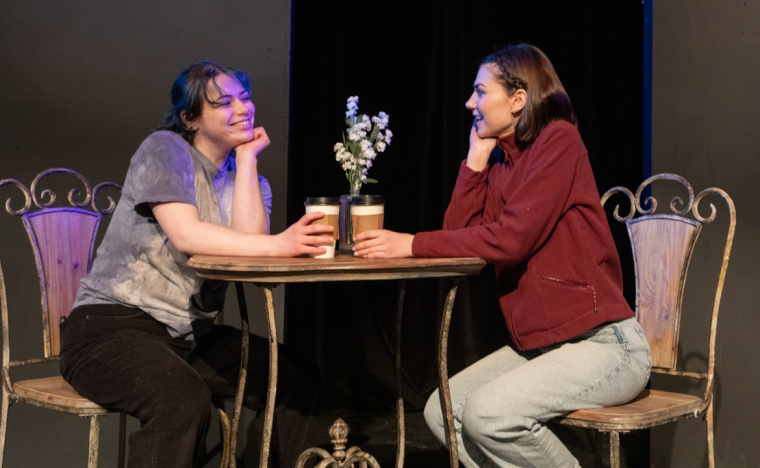
The night's final piece was director Kara Taghon's Yellow for Home. At first, it presents itself as relatively straightforward. Sara (Elissa Dynes), a bookstore-coffeehouse barista, befriends Carly (Kassidy Holdridge), a customer who arrives in the morning and stays all day, day after day. Gradually, the audience learns this is a missed-connection story: Carly previously met Lily (Ivy Browne), and without exchanging contact information, decided to return to the same place the next day, hoping fate would intervene.
This was, for me, the production's most emotionally resonant piece. Holdridge and Dynes share a wonderful dynamic, their friendship unfolding with an ease that felt almost reminiscent of an Oscar-and-Felix pairing – two very different personalities finding a rhythm together. Then, when we were allowed to see it, Browne brought a distinct and welcome chemistry when paired with Holdridge. Meanwhile, Jaina Gliva was consistently hilarious in the background as Alyssa, the second barista. (Truly, keep an eye on her relationship with the coffee pot.)
I found myself fully invested in Carly and Lily’s story and the possibility of what might happen. And yet, I suspect the truer story here is the quieter one: the evolving friendship between Sara and Carly, and the way shared time builds connection. The passage of time is marked subtly and effectively by the changing flowers on the table, a small design choice that I loved.
I was thoroughly caught up in Yellow for Home, right up until the final scene. At that point, I will admit that I lost my footing entirely. There was a fog machine. White nightgowns. Dancing. I would love to say that a few days of reflection have brought clarity, but if anything, my confusion has only deepened. I wouldn’t go so far to say it ended the evening on a sour note, but it did feel like a sharp tonal departure, one that left me more puzzled than moved as the house lights came up.
As we are left to ponder What Might Have Been, I definitely appreciate its title: each piece had an element left to chance or ambiguity. Barely There Theatre operates on the “Pay what it’s worth” model, and at least the talent isn’t up for discussion: The skills of its current team are certainly above debate.
Barely There Theatre's What Might Have Been runs at the Black Box Theatre (1623 Fifth Avenue, Moline IL) through February 7, and more information and tickets are available by visiting Facebook.com/BarelyThereTheatreQC.