
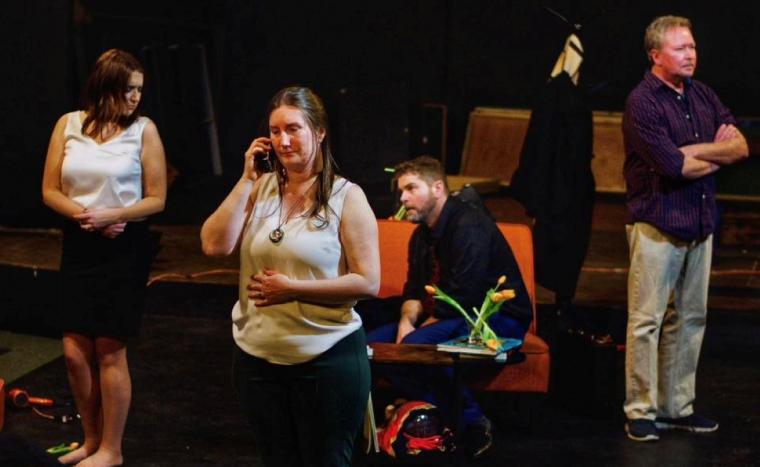
Leslie Day, Stephanie Burrough, Thomas Alan Taylor, and Mike Schulz in God of Carnage
Need a laugh? Need 40? Playcrafters has them for you.
The Barn Theatre's season opener God of Carnage has a forbidding title, but is actually a contemporary comedy peppered with uncomfortable moments. Yasmina Reza wrote Le Dieu du Carnage in French, though a German version of it premiered in Zürich in 2006. Christopher Hampton's English translation opened in London in 2008. He Americanized his script before its Broadway debut the next year, and it won three Tony Awards, one of them for Best Play. Roman Polanski directed the film adaptation Carnage in 2011, and here, director Jeremy Mahr has turned this well-crafted script into refreshing entertainment with four platinum-level performers.
Reza's story concerns two couples who meet to discuss an altercation between their 11-year-old sons. Stephanie Burrough and Reader employee Mike Schulz play the injured parties Veronica and Michael Novak, parents of Henry. Leslie Day and Thomas Alan Taylor play Annette and Alan Raleigh, whose son Benjamin hit Henry hard enough to break teeth. The clash of classes is evident.
Hampton gave the characters new surnames in his translation, and they're as evocative as their French counterparts. “Raleigh” is a decidedly WASP-y name with an aristocratic air, and “Novak” is a Slavic name (the word for “slave” in several languages comes from that demonym). As God of Carnage starts, the apprehensive Raleighs are seated in the Novaks' modest living room. The coffee tabletop and under-shelf are loaded with books on the arts and culture. There’s even a tall stack of tomes next to it, and a side table similarly burdened – code for “We’re intellectuals!”

As parents of the aggressor, the Raleighs are at a disadvantage, but they take care to broadcast a different aesthetic, underlining their affluence. Alan is a lawyer, frequently and ostentatiously yammering into his cell as a threat display. Annette’s shoes, black pumps with blood-red soles, are either the iconic Louboutins or a knock-off, and she’s seated in a convoluted position so as to flash that warning coloration. Her occupation? “Wealth management,” she says, which is a legit profession, but which I take to mean “shopping.” She could’ve worn less ostentatious shoes, or kept her feet flat on the floor, for this meeting. He could’ve muted his phone.
Similarly, the Novaks could have cleared the 15 pounds of books from the coffee table, especially since they actually serve coffee, but the volumes’ physical and scholarly weight is a buffer against their guests/adversaries. Michael is a wholesaler, and Veronica a history writer and part-time clerk; they’ve got to intimidate somehow. One clash between the couples begins with the Novaks’ offering of adulterated clafoutis, a deeply French dessert. I couldn't understand why characters expressed (visual) disdain for Veronica’s substitution of apples and pears until I looked it up: Seems that clafoutis is traditionally composed of black cherries in custard. But at least for Alan, if it's not too vulgaire to say, the dish is a hit. It also comes up more than once.
At the show's beginning, Day’s Annette is supremely uncomfortable. She squirms in her seat like a tweaker with poison ivy, and grimaces like she smells doo-doo. Her words are polite, but Annette's body screams, “Get me out of here!” Yet she does evolve, or devolve, as the meeting goes on and her manners wear thin, which is a satisfying sight. As Alan, Taylor walks around doctoring the spin in believable, one-sided cell conversations with his colleagues and client. Also, he devours the peasant-made clafoutis like a rapacious beast. He’s hail-fellow-well-met friendly at times, but can turn menacing and condescending.
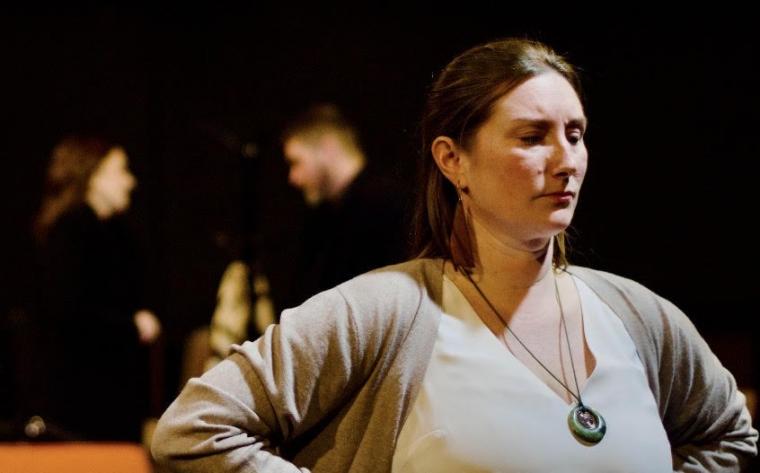
The mood swings of Schulz’s Michael are more startling, sometimes inexplicable – he morphs from a placating near-submissive into a callous near-thug, and back. His physicality and expressions can imbue a bland, innocuous line with pure hilarity, or a menacing chill. Burrough’s Veronica is at once the most grounded and most vulnerable. She holds the moral high ground (though she rubs it in the others’ faces), and implodes more than explodes. Ultimately, like for the rest of them, every other person in the room becomes her enemy. Burrough’s usually calm demeanor and realistic acting are commendable, and welcome in the midst of the chaos.
Startling physical bits, which the cast throw themselves into full force, come suddenly, so keep your eyes open. Verbally, calculated little digs and blatant insults alike lead to guffaws and/or gasps. Before the show, we'd been given multiple written and oral content warnings of harsh language, denigrating epithets, and adult situations. There’s also a head’s-up about simulated vomiting. On Friday’s opening night, only a buzzing speaker marred this oddly delightful 85-minute production. God of Carnage's escalating conflict, though horrifying if it happened to you, is written and played for laughs, and I like it that way. This dark comedy says plenty about human nature, but I’d rather howl at gallows humor than ruminate seriously about privilege and cruelty. Pardon my French: C’est hilarant.
God of Carnage runs at the Playcrafters Barn Theatre (4950 35th Avenue, Moline IL) through March 8, and more information and tickets are available by calling (309)762-0330 and visiting Playcrafters.com.