

Abby Bastian, Tyler Henning, Chris Tracy, Kirsten Sindelar, Kat Jecklin, and Tommy Ratkiewicz in I Love You, You're Perfect, Now Change (photo by Capturing Fireflies Photography)
Are you looking for love? For marriage? Or just trying to get past your partner’s daily idiosyncrasies? You may well love I Love You, You're Perfect, Now Change, whether you attend solo or with a date.
The 1995 musical, with book and lyrics by Joe DiPietro and music by Jimmy Roberts, is a collection of songs and scenes united by theme, not plot. It grew out of a music-free sketch revue titled Love Lemmings, and became the second-longest-running off-Broadway musical. (Twelve years with 5,003 performances; impressive, although still well behind the longest-running, The Fantasticks, with 17,162 performances). At last count, this show has since been translated into 17 languages. “Successful” is an understatement. It’s now playing at the Black Box Theatre, with co-founder David Miller as director and chief designer, and pit maestro Randin Letendre as music director.
On Friday's opening night, the talented cast, crew, and musicians did very well with what they were given; for me, the material’s attempts to please everyone diluted its overall impact. The big-life-transition-themed production itself has the vibes of this venue’s 2022 Motherhood: The Musical (which Miller also directed). And the buoyant, kinetic, unshakable cast members, veterans all, are Abby Bastian, Chris Tracy, Kathryn Jecklin, Kirsten Sindelar, Tommy Ratkiewicz, and Tyler Henning, who make their multitudinous songs and quick transformations into dozens of disparate characters look easy – and the feats can't possibly be.
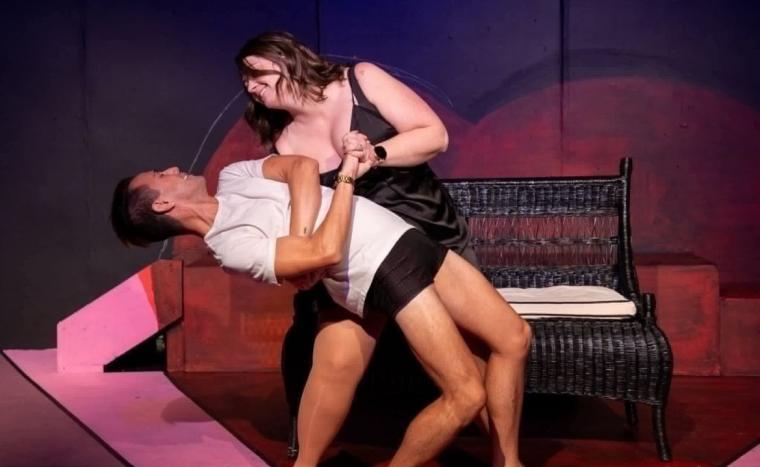
Like the résumé of DiPietro – his credits include All Shook Up, the four-time Tony Award winner Memphis, and the nine-time Golden Raspberry Award-winning Netflix film Diana: The Musical – I found I Love You, You're Perfect to be a mixed bag, as well. Granted, it was written more than 30 years ago, but some of its alleged humor dates to 30 years even before that. The show begins with a depiction of female heavenly entities taunting their male counterparts about committing to the rigors of monogamy. (Thankfully, no literal balls-and-chains were depicted.) Though the Black Box's version of the book is the one updated in 2018, most notably with a song about dick pics, some of the tropes, including “women love shoe shopping” and “bridesmaids’ dresses are ugly,” were already tired in the ’90s. I do, however, forgive the musical for the latter cliché, as it's the hook on which hang the assorted oddball frocks described in “Always a Bridesmaid,” a gorgeous country ballad. Among other fine moments, “On the Highway of Love” found a family of four ingeniously turning office chairs into a moving car while squabbling and singing, while Act I concluded amusingly with the whitest gospel wedding in history.
DiPietro's book walks a fine and tricky line: It wants to be observant and relatable and wring humor out of couples’ conflicts, and doesn’t always succeed. However, one of the best numbers does both. “Hey There, Single Gal/Guy” not only depicts a fresh conundrum – a former couple confessing their breakup to his parents – but also triumphs in entertainment value. Another song that turns a well-worn theme on its head is “Shouldn’t I Be Less in Love With You.” In it, a husband reflects on his devotion after decades of marriage, despite the statistics and predictions of failure.
I also enjoyed “A Stud and a Babe,” featuring a couple of first-date introverts, both science-fiction-franchise fans, trying to pose as the type each thinks the other would be impressed by. The penultimate number, “I Can Live With That,” starts with the wacky premise of a man trying to pick up a woman in a funeral home. I feared it was going to degrade into slapstick, perhaps even with Laugh-In-style purse-thwacking. However, unexpectedly, it becomes both sweetly humorous and touching.
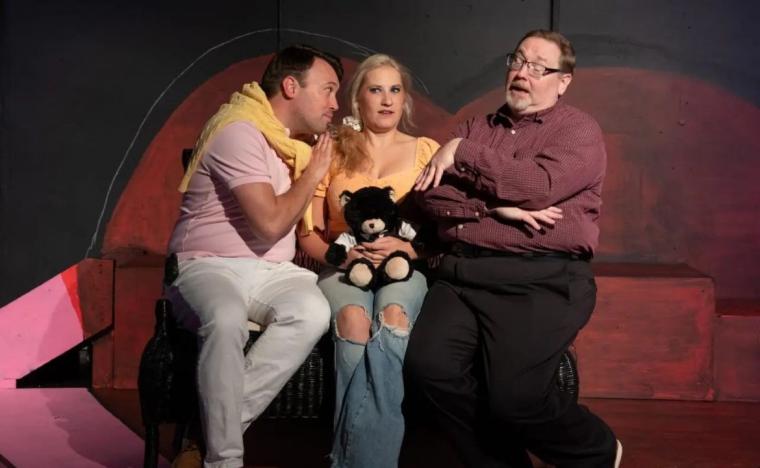
Not every choice was as satisfying to me. I get that in this quick-change format of theatre, each performer typically has less than a minute to establish character. But I wish the married gay men, who were added in the 2018 I Love You, You're Perfect, Now Change rewrite, had each been infused with more individuality and not presented as nearly identical-twin caricatures. Still, their hyper-fixation on their new baby – and the reactions of the babysitter whose tolerance was at the breaking point – were played wonderfully.
Letendre's four-piece orchestra was excellent; the sound balance was just right, and the singers matched them in tuneful professionalism. Miller's set was attractive and functional, his lighting was lovely, and kudos to the uncredited costumer for the multitudinous ensembles. If even a jaded cynic like me can get a kick, albeit an occasional one, out of this show's renditions of love, perfection, and change, so can you.
I Love You, You're Perfect, Now Change runs at the Black Box Theatre (1623 Fifth Avenue, Moline IL) through October 24, and more information and tickets are available by calling (563)284-2350 and visiting TheBlackBoxTheatre.com.