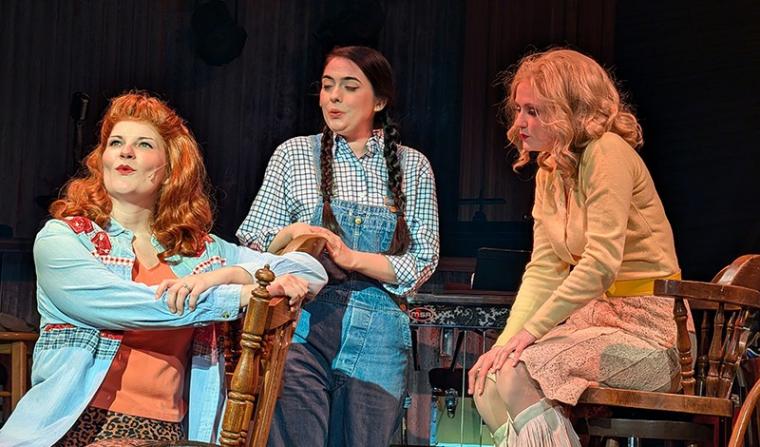
Syd Richardson, Jennifer Barnaba, and Hannah Marie Felver in Honky Tonk Angels
Do you have a hankerin’ for a hootenanny? If you enjoy the songs of female country-music stars such as Dolly Parton, Loretta Lynn, and Tammy Wynette, you are guaranteed to love Honky Tonk Angels, now on stage at the Circa '21 Dinner Playhouse.
Directed by Tristan Tapscott, this musical tells of three women blessed with tremendous singing talent, each of them making their way to Nashville to pursue their music-making dreams. Angela (Syd Richardson) is an underappreciated housewife; Darlene (Jennifer Barnaba) is a coal miner’s daughter; and Sue Ellen (played by Hanna Marie Felver the night we saw it; Marion Stenfort will take over for most of the run) is fleeing harassment from her boss. Their backstories are different, but as soon as they meet on the bus, they forge a powerful, harmonious bond. In Nashville, they parlay their shared gifts into a months-long gig as the titular “Honky Tonk Angels” at a bar called (what else?) “Honky Tonk Heaven,” and the show's plot is really just a bare framework on which to arrange the songs. We caught the March 13 performance.
Mischa: Tapscott made some introductory remarks before the show, encouraging the audience to simply enjoy the fun, arguing that not everything has to be “deep.” In some ways, though, I’d say that’s selling this material short. Sure, the plot is far down on the threadbare end of the spectrum. But the songs themselves, and the performances, often have depth and meaningfulness that goes well beyond simple entertainment.
Kitty: I have to agree. It’s actually kind of embarrassing how often I teared up. And trust me, I was not expecting to get emotional during a show whose title contains the words “honky tonk.” But some of these songs are surprisingly poignant.
M: I loved the three singers’ perfectly balanced harmonies and blended voices – throughout the entire show, really, but most touchingly in contemplative numbers like “Sittin’ on the Front Porch Swing.”
K: That was my favorite number! It’s a simple melody that really relies on the performers to make it compelling, which they definitely did. That was a teary moment. Another came during the classic “I Will Always Love You,” which I was only too delighted to inform you was written by Dolly Parton.
M: I’m mortified that I did not know that. I should also say that these performers’ absolute coordination also stood out in faster-moving songs such as “I’ll Fly Away.” Together, they were unstoppable. Well … individually they were pretty unstoppable, too!
K: Like you said, Honky Tonk Angels' storyline is thin at best – more so, even, than in most jukebox musicals. I feel about this show kind of like I felt about Glee. I wasn’t in it for the plot, but I was hooked by the music.
M: Okay, that makes sense.
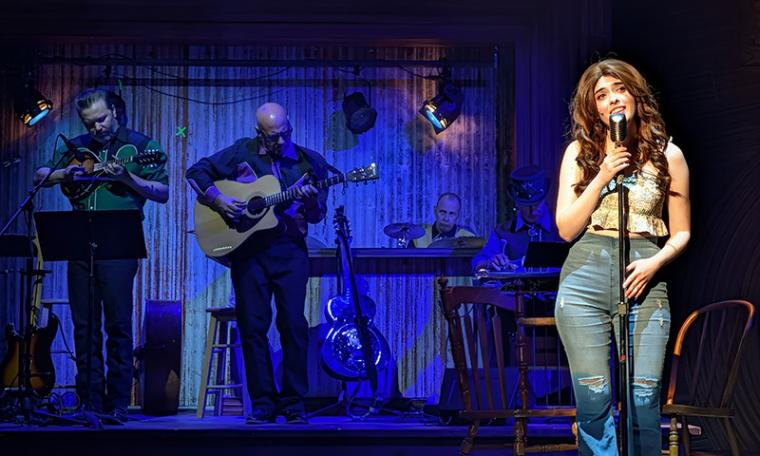
K: And what I loved was that each actor performed each song as its own story. I think that’s what made it all work for me. Because, really, this show is women singing about the female experience. So hearing Barnaba sing a tragic tale like “Ode to Billy Joe” and then listening to Richardson follow it up with “Don’t Come Home a Drinkin,’” which has a very different tone but no less fervor, was unexpectedly powerful. It showcased the wide range of emotions women navigate. Each performance felt like a new chapter in a much larger, collective narrative. Not to overstate it, but it was kind of like The Vagina Monologues of country music.
M: And I would add that each performer also presented strong, distinct character choices in their acting outside the songs, from Richardson’s over-the-top chattiness to Barnaba’s quiet bashfulness to Felver’s moves toward self-assertion. They effectively brought their characters' personalities to life even though the book doesn’t give them much to work with.
K: Another great source of personality was the band. Not only did they provide live instrumental music, they also chimed in as background characters throughout, which I thought added some color. They especially brought flavor to the Greyhound-bus scene.
M: Yeah, they definitely got into the task of playing the other passengers, even while continuing to supply musical accompaniment. That scene also gave us the best example of the number of versatile uses of the space itself – such as the lighting, and the tables and chairs belonging to the main “bar” set, used to create various environments in the first act.
K: Oh, that’s a really good point.
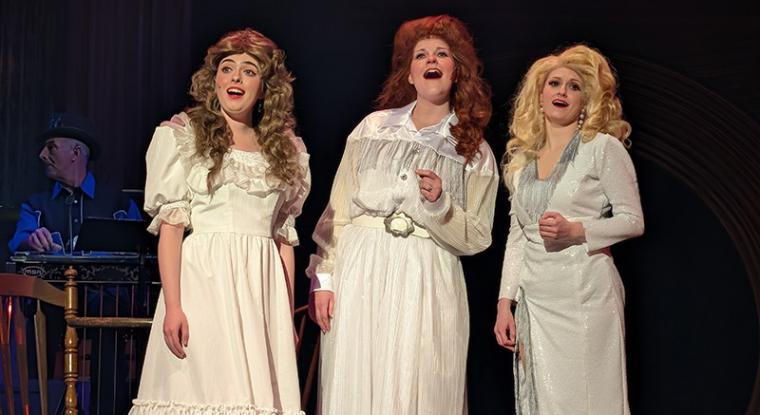
M: And that bar set itself was striking, with a large partial guitar shape as the back wall, including a circular entryway through the sound hole. Kudos to set designer Becky Meissen and lighting designer Heather Hauskins.
K: I thought that using the bar tables and chairs to create the Greyhound was ingenious, but I actually wasn’t fully sold on the specificity of the set. The onstage bar definitely set a strong tone right away, and it worked really well in the second act, which takes place entirely in Honky Tonk Heaven, But I thought it was out of place for the first act. Something a bit more neutral might have been a better fit. Although I did love the guitar silhouette on the back wall.
M: Speaking of guitars, allow me to give more props to the crackerjack live band. They were essential in creating the atmosphere, and they really delivered. I especially loved Tom Pickett’s steel guitar, but they all deserve a shout-out: Steve Lasiter (guitar), Emmett Boedeker (keyboard), Brad Hauskins (bass), and Scott Pauley (drums).
K: This show was a fun surprise. If you’re looking for good music and even better performances, Circa's latest is one honky tonk you won’t want to miss.
Honky Tonk Angels runs at the Circa '21 Dinner Playhouse (1828 Third Avenue, Rock Island IL) through April 25, and more information and tickets are available by calling (309)786-7733 extension 2 and visiting Circa21.com.