
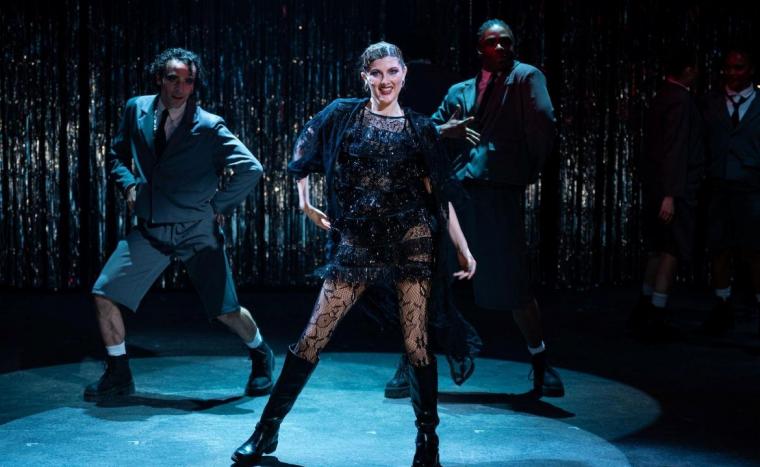
Jose Emilio Escoto, Carly Garcia Walton, and Isaiah Baston in Cabaret
When I entered the Timber Lake Playhouse for its July 3 opening night of Cabaret and saw the stage draped with a gold foil fringe curtain and framed in marquee bulbs with a glowing red “KIT KAT KLUB” sign, the atmosphere felt equal parts seductive, artificial, and just a little bit unsettling.
Directed by Christian Fleming, this Kander & Ebb musical classic is set in 1930s Berlin, where the Weimar Republic has begun to fracture under the pressure of fascism. The Kit Kat Klub serves as pleasurable escape for people such as Clifford Bradshaw (Shea Curran), who becomes enamored of nightclub headliner Sally Bowles (Carly Garcia Walton), while the Emcee (Miller J. Kraps) drives the action as a flamboyant but foreboding presence, reminding the audience that reality is lurking beneath the glittery surface.
Fleming’s set is simple, and I mean that as a compliment. There’s a sort of “stage within a stage,” with conductor/pianist Matthew W. Surico's band arranged on either side, effectively framing the action as much as accompanying it. Later, when the story shifts to Cliff’s boardinghouse room, the transformation is almost comically minimal: a mattress, a blanket, and a desk and chair. That sparseness works, even though there are moments in which the frequent hauling of furniture drags the momentum a bit.
The design's simplicity felt deliberate, and it definitely worked to control the audience’s focus. That control is there immediately in “Willkommen,” which is one of the strongest opening numbers I’ve seen in a while. Kraps entered like a secret being told in real time. Just his head was visible at first, peeking through the gold fringe curtain with a red-lipped smile that felt equal parts invitation and threat. When he fully emerged, he revealed a gorgeously provocative silhouette: cockeyed top hat, lace bodysuit, red leather codpiece brazenly displayed beneath a voluminous tulle skirt. Costume designer Gregory Gale created an entire character study with just this one outfit.
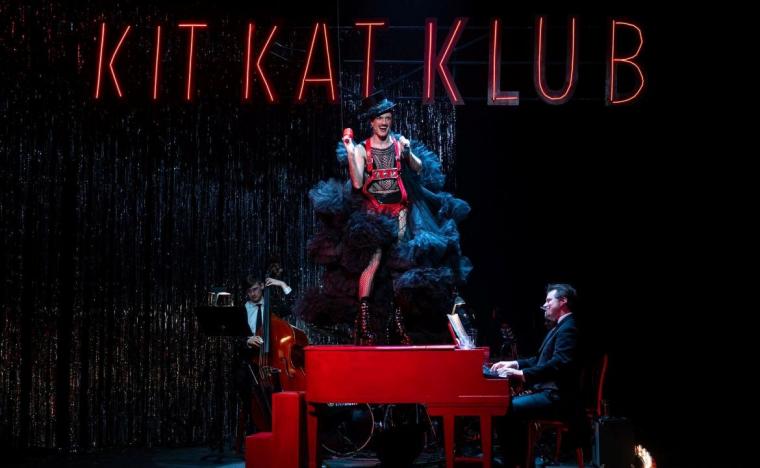
Kraps was definitely one of this Cabaret's standout performers. His Emcee was seductive, funny, and constantly aware of the audience in a way that felt almost invasive. When he delivered his iconic greeting, “Meine Damen und Herren, Mesdames et Messieurs, Ladies and Gentlemen,” I somehow felt like he was calling each of us out by name. His charm was captivating, which made the menace underneath it even more unsettling. He was like a spider whose prey doesn’t notice the web until they’re already inside it. What made his portrayal especially effective was his seeming omnipresence onstage. Even in scenes outside the Kit Kat Klub, he lingered in the background as an observer casting silent judgment on the action as it unfolded. His presence created a slow, creeping sense that the boundary between performance and reality was thinner than it should be.
Walton’s Sally Bowles was high-energy with higher emotions. Her vocals were strong, although I noticed that she opted to “speak-sing” some of the lower notes. In “Don’t Tell Mama,” she was fast, electric, and full of surface confidence, but in “Mein Herr,” she really locked in with alluring physicality. If the Emcee was trying to threaten us individually, she was trying to seduce us. Later in the show, she gave a heartbreaking rendition of “Maybe This Time,” her voice tinged with the desperation of someone trying to convince herself that good things are possible, even though she clearly doesn’t believe it.
Curran’s Cliff provided a steady counterbalance to Sally, open to the excitement of Berlin, but never fully seduced by it. Even at his most engaged, there was a sense that he was seeing things more clearly than those around him. As the show went on, that awareness sharpened into something more sobering, particularly as the shadow of Hitler’s Reich loomed dangerously over his personal life. Curran gave Cliff a jaded sadness that really made me feel sorry for him. By the time Cliff’s relationship with Sally reaches its inevitable end, he seemed exhausted more than heartbroken – like someone finally realizing the party was never worth the cover charge.
As Fräulein Schneider, Heather Patterson King delivered one of the production's most grounded performances in the production. When she sang “What Would You Do?” with quiet emotional weight, King captured the impossible conflict between love and survival, and it hit me harder than I expected.
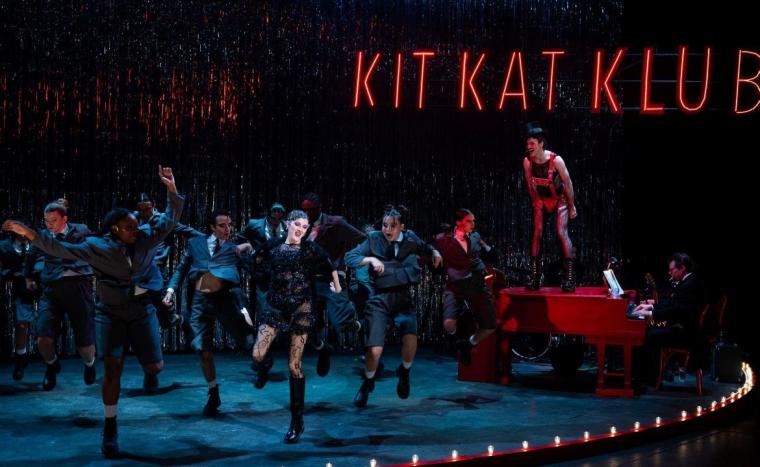
But the most unforgettable moment of the night doesn’t belong to a single performer. It came courtesy of the ensemble during the “Entr’acte.” They began with an energetic dance number (choreographed by Trent Soyster) where they slowly removed their shoes and placed them in a semicircle just beyond the stage lights. Then they each removed a few articles of clothing and passed them off to the Emcee, who collected the discarded garments and placed them downstage center, surrounded by the shoes. A spotlight shone down on the pile of gray fabric, and it stayed there for the rest of the show. The effect made me gasp. If you’ve ever seen the Holocaust Museum’s display of confiscated shoes in Washington, D.C., the association is immediate and difficult to shake. The image landed with quiet, unbearable weight.
That visual was then fully realized in the show’s final sequence. During “Cabaret,” her final performance, Sally angrily yanked down the foil curtain to reveal a stark concrete wall, collapsing the glamour of the Kit Kat Klub completely. Later, during “End of Show,” the cast exited one by one through a single door in that wall. Even the band left, one instrument at a time, until the only people remaining on stage were the Emcee and those wearing swastika armbands. It wasn’t an exit so much as a systematic erasure. I found myself in tears before it was over.
This isn’t merely a well-executed production. It’s a reminder that life’s most dangerous horrors rarely announce themselves all at once. They arrive draped in glamour, smiling through gold fringe until the stage door finally slams shut.
Cabaret runs at the Timber Lake Playhouse (8215 Black Oak Road, Mt. Carroll IL) through July 12, and more information and tickets are available by calling (815)244-2035 and visiting TimberLakePlayhouse.org.