
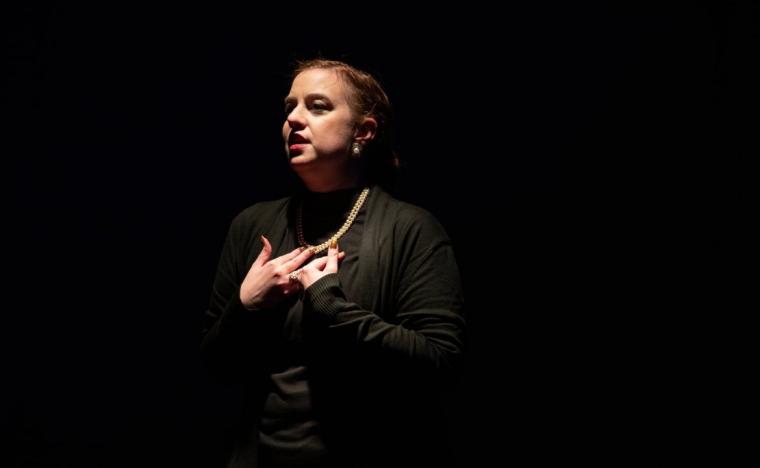
Shelley Cooper in Master Class
Pairing up with Opera Quad Cities proves to be a recipe for greatness at the Black Box Theatre, because make no mistake: There's something truly special about Master Class. Written by Terrence McNally, the play follows legendary opera diva Maria Callas, portrayed here by Shelley Cooper, as she conducts a master class for aspiring singers at the Juilliard School. Interwoven between the lessons or, more accurately, pointed critiques, Callas reflects on both the triumphs and sacrifices that shaped her life and career.
Directed by Ron May, Master Class is delightfully self-aware. There is no fourth wall, and in fact, quite a bit of time passes before the house lights even dim. The intimacy of the Black Box space makes this choice especially effective as Callas immediately establishes the rules of her classroom: We are not to applaud. Cooper, brilliant from the outset, makes direct eye contact with audience members to ensure we understand exactly who is in control. Dressed in an all-black ensemble, complete with impractical heels and oversize sparkling earrings, Cooper commands attention the moment she steps onstage. Her formidable portrayal expertly captures both the grandeur and sharp edges of Callas’ personality.
Michelle Crouch serves as accompanist for the class, and my only disappointment, on Saturday, was that there was not more music for her to play. Crouch performs beautifully throughout, and her few lines bring about some warmth to balance out Callas’ coldness. The set, designed by Lora Adams and wisely kept simple and formal, features a grand piano that almost becomes a character in itself as it dominates the small playing space.
Tyler Henning’s stagehand character may be the only person in the room wholly unimpressed by Callas. Though he technically fulfills every request she makes, he does so with understated irritation. What works particularly well here is May’s restraint in directing the role. Henning could easily have turned the character into a recurring comedic gag, but instead, each appearance feels grounded and honest, making his reluctant incredulity feel humorous without crossing a line.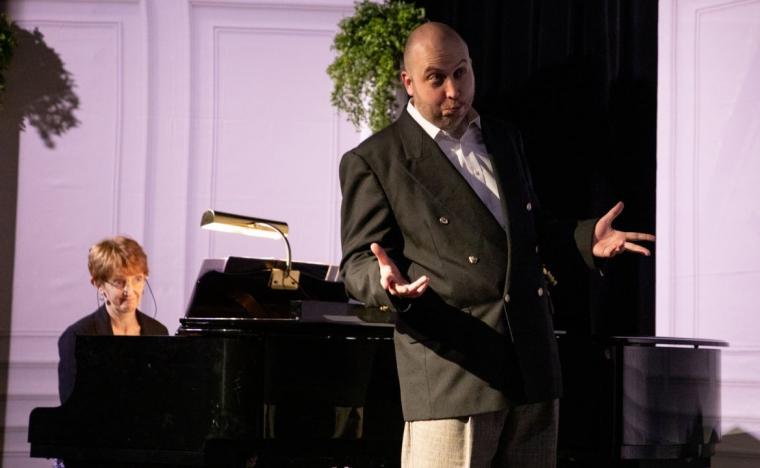
Callas' first student, portrayed by Sarah Lounsberry, is cut off almost immediately after beginning her aria. This is unfortunate, both because Lounsberry possesses a lovely voice, and because for a play centered on opera, the first act contains less singing than one might expect. Instead, Callas and the soprano dissect the emotional truth of the piece, a conversation that gradually transforms into something resembling a breakdown as Callas confronts her own memories and insecurities. A dramatic lighting shift by fellow Reader reviewer Alexander Richardson transports us directly into Callas’ inner world as she relives her own performance of the same aria.
One of the most fascinating elements of Master Class is the tension between humor and discomfort. Are we laughing because something is funny, or because the situation is painfully awkward? Cooper navigates that line masterfully. Her take on Callas can be biting and unforgiving, but the feedback is always rooted in brilliance, and an undeniable desire to push her students to be better.
After a short interval (the show's intermission), audiences are introduced to two more students: Brent Behrens' tenor and Madalynn Baez's soprano. Behrens provides an engaging contrast to the female students because he pushes back against Callas’ critiques rather than shrinking beneath them – a resistance that creates some compelling exchanges. Even Callas herself seems delighted by his voice, and Cooper mirrors the audience’s reaction as she visibly revels in listening to him sing.
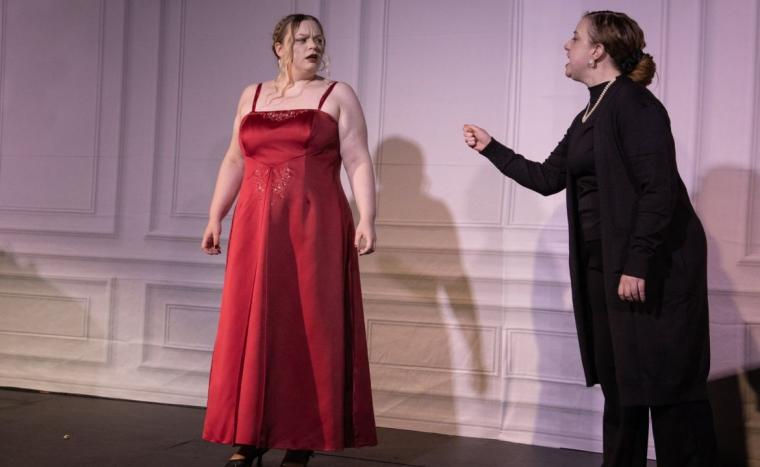
Meanwhile, Baez begins with a faltering confidence and stiffness before finding her footing as the lesson progresses. She does an excellent job leaning into the character’s meekness without making her feel one-dimensional, and truly, it takes immense talent to convincingly portray awkwardness onstage. As the student pushed hardest by Callas, Baez ultimately delivers one of the evening’s most satisfying transformations. Her costume subtly reinforced this journey, as this red dress immediately sets the soprano apart from the production’s otherwise black-and-white, neutral palette. During these moments with Baez, Cooper also shines as she steps completely into the house making off-handed side comments. We see that Callas really is a master herself; her advice and feedback is sound, and helps the student grow as a performer.
This final student also allows Callas to spiral into despair as we learn all that she had to balance for her career, and Callas sacrifices everything, including her voice. Richardson’s lighting again gives us nowhere to focus but on Cooper, and the harsh lighting makes a poignant statement during the reflection on the sacrifices demanded by greatness, but also on the fragility of human existence.
Though fictionalized, McNally's play is filled with very real insights about performance, discipline, and the purpose of art itself. In the end, Master Class is a passionate meditation on why art matters, as well as a production that features some truly lovely singers indeed. Hitting all the right notes literally and metaphorically, this production’s an experience I wholeheartedly recommend.
Master Class runs at the Black Box Theatre (1623 Fifth Avenue, Moline IL) through May 24, and more information and tickets are available by calling (563)284-2350 and visit TheBlackBoxTheatre.com.