
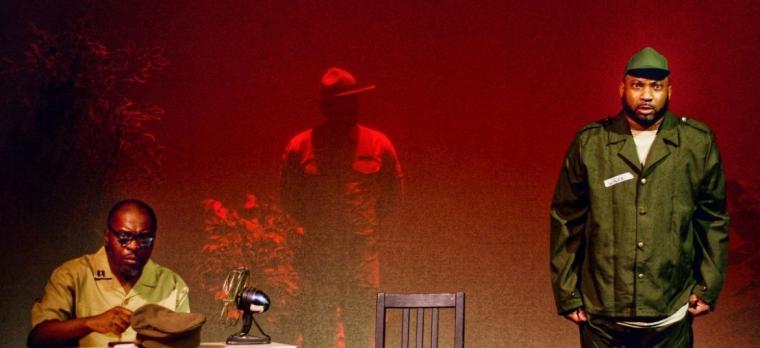
Ashley Harris, Antonio Stone, and Aaron Shivers in A Soldier's Play
If you’re looking for an easy, sit-back-and-relax night at the theatre, then A Soldier’s Play is not for you. Charles Fuller’s Pulitzer Prize-winning drama, now being staged at the Playcrafters Barn Theatre, has no interest in letting its audience remain comfortable. From its opening moments, it pulls viewers into a mystery layered with tension, prejudice, and uneasy realities. Director Renaud Haymon's production brings a gripping military investigation to life.
Set on a segregated Army base during World War II, Fuller's play follows Captain Davenport (Ashley Harris), a determined black officer and lawyer who is sent to investigate the murder of Sergeant Waters (Antonio Stone) – also a black officer – whose rigid, deeply divisive leadership style has left a lasting impact on the men under his command. As Davenport questions the soldiers in Waters’ unit, the story he uncovers reveals fractures within the ranks that extend beyond the crime itself. With its strong script and morally complex characters, A Soldier's Play sets the stage for a powerful, layered theatrical experience. We caught the performance on Saturday, April 25.
Mischa: First of all, the cast is great. In particular, I have to applaud Stone’s commanding performance throughout. In multiple flashback scenes, he convincingly portrays all of Waters' facets, from his harshly barked orders to his abject inebriation, and this really ties the whole play together.
Kitty: I thought that he also had the most convincing “military persona” of the cast. His posture and vocal inflections left no doubt about the sergeant's staunch authority. Waters is an intriguing character because we feel some level of pity for him – he is the murder victim, after all – but he’s also revealed to be deeply unlikable. Private Peterson (Jeramie Coleman), on the other hand, is instantly likable, but his quick temper makes him an unpredictable force. Coleman’s charm was a wonderful contrast to Stone’s severity. Watching the two of them clash so fiercely was riveting.
M: For sure. And there was a third actor, Dwayne Hodges, who provided a big contrast to both Stone and Coleman, but delivered an equally compelling performance. His character C.J. Memphis’ passionate blues singing takes on great thematic significance as it brings his fellow soldiers together, even as Sergeant Waters resents him for it. And his story is heartbreakingly central to the plot twists.
K: I totally agree. Hodges’ portrayal had a magnetism that made me root for him right away. One of the first things I said to you right after the show was that the other actors seemed to feed off his presence. It felt like Hodges was driving the energy of every scene he was in.
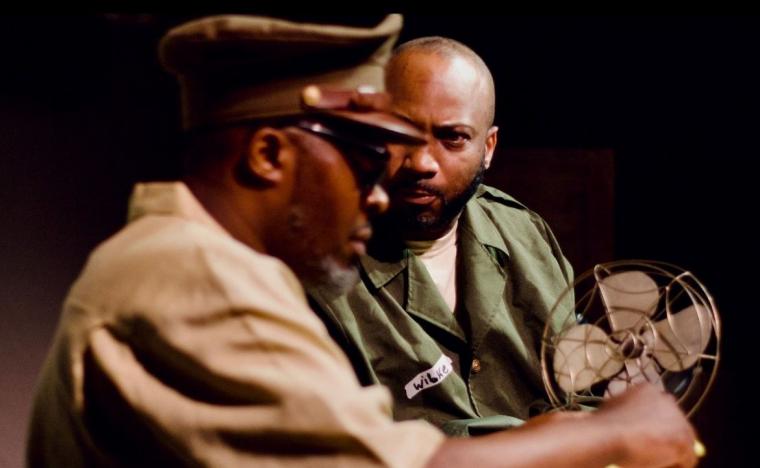
M: One of the script's challenges is that the past and present are intermingled: Captain Davenport’s interviews with the different members of the unit fade into remembered scenes that come to life on stage. Often this meant transitioning to action taking place behind a scrim, which did clearly distinguish the time frames – .
K: But oh boy did that get cumbersome. I like the idea of the scrim. I really do. I understand why Haymon wanted to use it. But I think the flashbacks should've been more seamlessly integrated with the present. In the script, as characters individually recount their versions of events, they alternate between telling the story and participating in the reenactment of the narrative. Creating a physical barrier between the two worlds hampered that concept.
M: On the other hand, putting things behind the scrim made it easier to present certain scenes of violence, including the gunshots, for which sound and light effects – respectively designed by Juniper Eberhardt and Giovanni Macias – made for effective drama, as well. Sometimes the effects on Saturday didn’t seem to land smoothly. But they mostly did, and the acoustic blues used for underlay, transitions, and pre-show music perfectly matched the unfolding story.
K: I did like the music choices a lot, which was fortunate, because a fair number of music cues covered the scene transitions. And musically backed or not, those scene transitions felt too long.
M: In that respect, it appeared that some costume changes may have slowed things down. Yet the costumes themselves, designed by Coral Clark, worked well, presenting both the Army and baseball uniforms that symbolized both the segregation and the halting movements toward integration in the story.

K: Speaking of setting, Elle Winchester's scenic design itself clearly established the location with its rows of austere army cots and the American flag displayed upstage. But while the design concept was good, the arrangement left me frustrated. Each scene only used one section of the stage instead of making use of the entire space. Part of the upstage area was designated for the “office” scenes; the thrust in the center served as the barracks; and the area furthest upstage held the flashback sequences. This arrangement often kept actors far removed from the audience for long stretches of the show, and it honestly made the action less engaging.
M: It especially made the scenes in which Davenport questions different soldiers feel cramped, when these sequences are really key to the plot's progression. But before we finish, I want to circle back to praise one more actor, even though the praise is a little awkward. Scot Gehret played the most virulently racist white character in the play, Lieutenant Byrd, and fully conveyed the officer's hatred and contempt. Like a lot in A Soldier's Play, this wasn't comfortable, but it was very important in truly establishing the setting and context.
K: Yeah, Byrd is one of those characters who, the better the portrayal, the harder it is to watch. Playcrafters is very clear about the content warnings for this show. And part of what makes the production so memorable is its willingness to depict unvarnished reality.
M: It’s well worth seeing.
A Soldier's Play runs at the Playcrafters Barn Theatre (4950 35th Avenue, Moline IL) through May 3, and more information and tickets are available by calling (309)762-0330 and visiting Playcrafters.com.