
15
Jun
2009
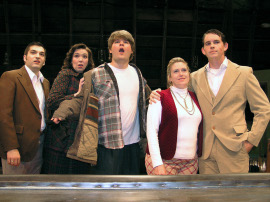 Over my many years of theatre-going, there isn't a stage trilogy I've enjoyed quite the way I've enjoyed the Pazinski-family comedies of author Tom Dudzick, a trio of lightly philosophical, understatedly touching, devastatingly funny plays that began with 1994's Over the Tavern and continued with 1998's King o' the Moon.
And I don't think I've ever loved a stage production quite the way I love the Richmond Hill Barn Theatre's current The Last Mass at St. Casimir's, the climactic chapter (written in 2002) not only in Dudzick's trilogy, but in Richmond Hill's, as Geneseo's Barn Theatre produced Over the Tavern in the summer of 2005, and King o' the Moon in the summer of 2007.
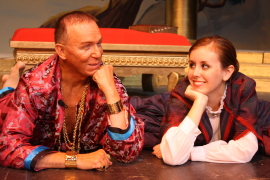 Quad City Music Guild's current presentation of The King & I is colorful and handsomely mounted, and in one scene, at least, it's even surprising, particularly if you don't peruse the program's cast list before the production starts. (Please skip the next two paragraphs if you don't want the surprise ruined here.)
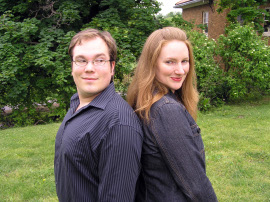 Jason Robert Brown's The Last Five Years is perhaps the best-known, most widely adored American musical that, in all likelihood, you've never heard of. Unless, that is, you're well-versed in modern musical theatre, in which case Brown's two-character, mostly dialogue-free offering probably isn't familiar so much as borderline-legendary.
 I love TV's The Office for many reasons, but the most basic is that nowhere else on television will you find a weekly ensemble of 16 performers, each of whom is consistently in character, and each of whom is consistently funny. No matter where your eye lands in a group scene, you find yourself grinning - if not laughing out loud - at some priceless reading or reaction, and that's what routinely occurs throughout the Timber Lake Playhouse's current, knockout presentation of Grease, a production that, coincidentally, also boasts an ensemble of 16 stellar comedians. (Seventeen, if you count the hysterical, wordless, run-on cameo by Jake Bollman.) And Timber Lake's troupe even tops the sitcom's office drones in one regard, because damn, but this staff can sing.
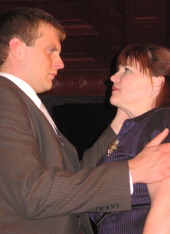 Sure, it's the Greek tragedy to end all Greek tragedies. But is any stage tragedy, Greek or otherwise, as unashamedly, wickedly enjoyable as that of the fall of Oedipus?
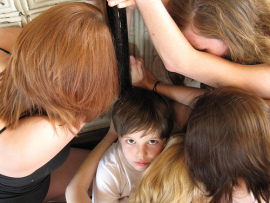 The Prenzie Players' presentation of Euripides' The Trojan Women, adapted by Richard Lattimore, runs just over an hour, and I can't imagine who would want it to last longer than that. There's so much anguish and grief on display, and the material appears so deeply felt by director Jill Sullivan-Bennin's cast, that the production leaves you not just haunted, but shaken; it's questionable whether either the actors or the audience could endure two hours of such extreme emotional states.
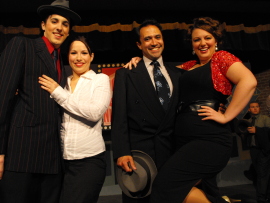 For the past 15 years, Muscatine's New Era Lutheran Church has staged an annual musical fundraiser, and I was moved to catch this year's offering for two (or rather, three) reasons: the casting of Jason Platt and Tracy Pelzer-Timm - two of our area's most entertaining character actors - in leading roles, and New Era's decision to produce Guys & Dolls, my all-time favorite musical, and certainly the least intimidating Great Musical ever written. Even at its worst, I reasoned, it would likely be a night well spent.
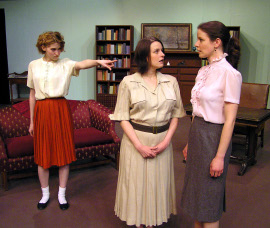 Originally produced in 1934, Lillian Hellman's The Children's Hour - the current presentation at the Playcrafters Barn Theatre - concerns a monstrous little boarding-school brat who falsely accuses her headmistresses of engaging in a lesbian affair, a charge that leads to parental panic, financial ruin, and the destruction of several lives. In an era that finds the Iowa Supreme Court legalizing same-sex marriage, Hellman's melodrama now seems more like a museum piece than it would have even two months ago, and so it was wise of director Patti Flaherty to set her production firmly in the past - even though that past feels less like the 20th Century than 400 BC.
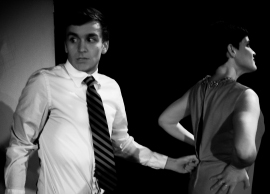 The Harrison Hilltop Theatre's The Graduate provides a respectable amount of fun, considering that almost nothing in it makes the least bit of sense. Adapted from Charles Webb's 1963 novel and/or Mike Nichols' seminal 1967 comedy, Terry Johnson's script frequently feels like the movie version on fast-forward - the playwright clumsily barrels through both the narrative and its complex emotional transitions - and the show's tone and performance styles are all over the map. Yet considering its frequently awkward and unconvincing elements, director Wayne Hess' comedy does at least offer one truly magical ingredient in Erin Lounsberry, whose performance here is insinuating, disturbing, sexy, and richly, deeply funny.
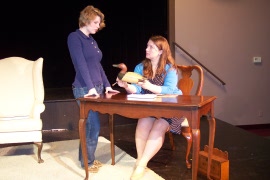 In the loveliest segment of the one-act monologue Going Back Naked - the first half of New Ground Theatre's Going Back Naked: Two Plays by Local Playwrights - author Melissa McBain, portraying herself, reads from her late mother's 70-year-old love letters, and lands on a passage wherein her Mom refers to the children she hopes to one day have with her young paramour. Marveling that she was being thought of a full decade before she was actually born, McBain takes a beat and smiles, and addresses her absent mother in tones of longing and wonder: "You imagined me."