01
Aug
2007
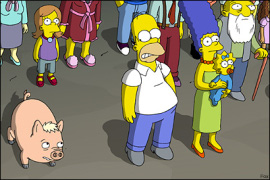 THE SIMPSONS MOVIE
The Simpsons Movie is perfect, by which I mean it's like a really good, really long episode of the show.








You'll get both the current official narrative challenge and What's Happenin' in the Quad Cities.
(Did you know we publish a new Real Astrology and RCR Crossword every week?)

Get the printed Reader edition mailed to you (or anyone you want) first-class for 12 months for $48.
$24 goes to postage and handling, $24 goes to keeping the doors open!
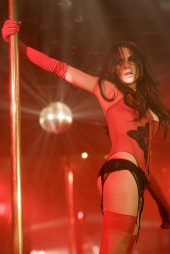 I KNOW WHO KILLED ME
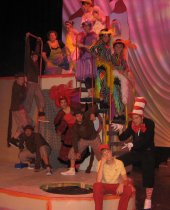 No childless adult should feel the least bit silly about attending the Countryside Community Theatre's madly enjoyable production of Seussical.
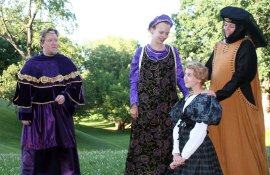 Saturday's Genesius Guild presentation of The Winter's Tale never quite found its tone, but it's hard to be too bothered by that, because I'm not convinced that Shakespeare's play ever finds its tone, either. The bard's work is an unusual, somewhat off-putting blend of high and low comedy, aching tragedy, and pastoral romance, and I can only assume that pulling it off in a way that makes sense requires an extraordinary amount of finesse. Director Patti Flaherty's production didn't display this sort of acumen, yet to its credit, the show was never less than pleasant. Whether The Winter's Tale is meant to be pleasant is another matter entirely.
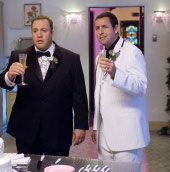 I NOW PRONOUNCE YOU CHUCK & LARRY
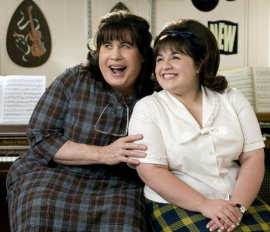 HAIRSPRAY
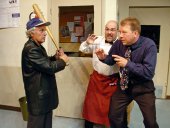 On Friday night, I attended a comedic farce that featured slamming doors, mistaken identities, gunshots, an unhelpful cop, a heavily accented mobster, an attractive woman getting sloppy drunk, and a finale that found characters staring with amazement at a briefcase filled with cash.
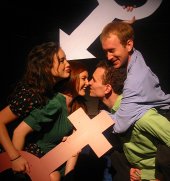 I Love You, You're Perfect, Now Change is composed of 20 comic vignettes that explore the difficulty of modern relationships, and at the Clinton Area Showboat Theatre's Wednesday-night performance of the musical, one scene found a young man (Joshua Estrada) overwhelmed by the kid-crazy perkiness of his new-parent friends (Alison Nicole Luff and Joshua Wright).
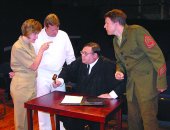 Imagine an episode of TV's The West Wing performed at half-speed, and underwater, and you may begin to approximate the experience of the Richmond Hill Barn Theatre's opening-night performance of A Few Good Men.
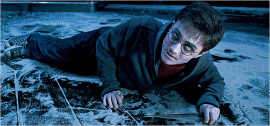 HARRY POTTER & THE ORDER OF THE PHOENIX