
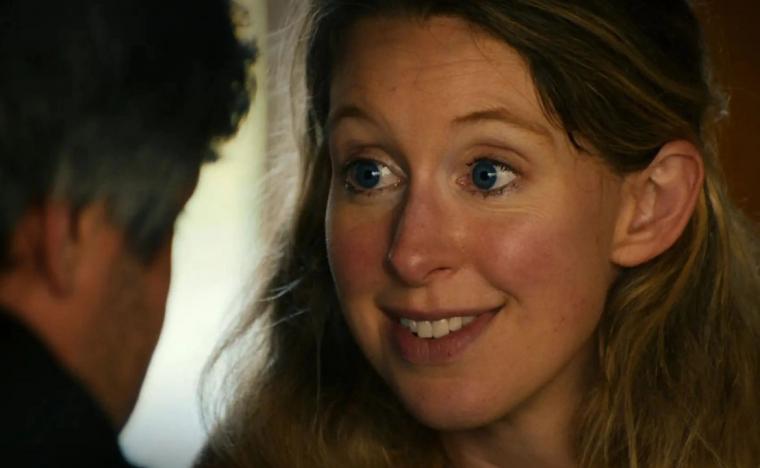
Elizabeth Holmes in You Can See Everything
YOU CAN SEE EVERYTHING
Until it turns into something more trenchant and far more mind-blowing, directors Nathan Fielder's and Lance Oppenheim's three-hour A24 documentary You Can See Everything – as transfixing a 2026 entertainment as I've yet seen – is like being at the most exciting Texas Hold 'Em game of your life.
At first, the poker-faced rivals appear to be the doc's ostensible subject Elizabeth Holmes, the Theranos founder sentenced to 11 years in federal prison on four counts of fraud (her tale recounted in Hulu's Emmy-winning limited series The Dropout starring Amanda Seyfried), and Fielder, the deadpan comic famed for his reality/absurdist-comedy shows Nathan for You and The Rehearsal. On umpteen occasions here, Fielder asks Holmes some variant on “Are you serious?”, be it in conjunction with her claims of innocence, her insistence that she has never told a lie in her life, or her abashed admission that she doesn't know the name of the first baseman right after being shown Abbott and Costello's “Who's on First?” routine. Her big, round, frequently unblinking blue eyes suggesting one of Spielberg's gentler aliens, Holmes makes assertions and stares at Fielder with an expression of such ingenuousness and unwavering conviction that she freaks you the f--- out, and her responses (or lack thereof) clearly affect Fielder, too. But he doesn't look freaked. He looks, as he no doubt is, fascinated, as though trying to peer directly into Holmes' soul and determine whether the cards she has buried are a pair of aces or simply an unhelpful deuce and six. Fielder asks “Are you serious?” and, by God, she is. But is she seriously telling the truth, or seriously pulling the wool over his eyes?
Make that our eyes. Because at some impossible-to-specify point before YCSE's second half, you begin to realize that Holmes isn't playing poker with Fielder so much as with us. There are, after all, cameras around, Holmes and her longtime fiancé Billy Evans – the father of their two young children – having agreed to participate in this project that would require, in Evans' phrasing, “radical transparency.” Strike that “participate in”: They (or at least Evans) recruited Fielder for the project, hoping to rehabilitate Holmes' public image and “set the record straight” about the nonfunctional blood-sampling device that landed Holmes on the cover of Forbes, as the world's first self-made female billionaire, before landing her in prison. Holmes and Evans know they're not performing (if that's the right word for it) for an audience composed solely of Fielder, Oppenheim, and their literal in-house team. They're performing for everyone watching the future end result of this filmed experiment. We're who Holmes and, increasingly, Evans are trying to convince of her genuineness, and the poker game gets infinitely more complicated after we recognize that Fielder himself might be leaning toward not calling the woman's bluff and, instead, letting her walk off with the whole pot. Maybe she doesn't deserve it. Maybe, astonishingly, she does.
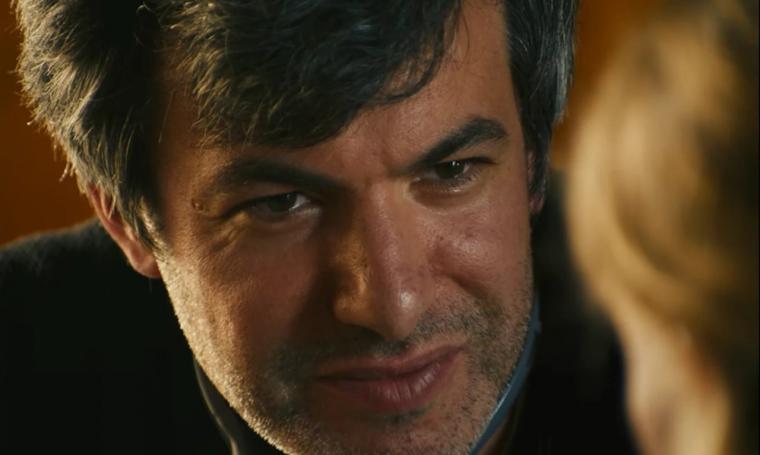
For three years, A24 kept word of You Can See Everything quiet – so quiet that few knew of its existence before the doc premiered as a “secret screening” at last month's Telluride Film Festival. The unusual release strategy perfectly befitted the movie's most unusual origins. Not long after the onetime Silicon Valley wunderkind was sentenced, Holmes and Evans (or Holmes through Evans) reached out to Fielder, inviting him and a crew to spend time with the couple, at their beachfront home in Del Mar, California, during Holmes' last 34 days before reporting to prison. We learn that Fielder was chosen because he could provide a “human” take on Holmes' story. It's not evident, however, just how familiar Holmes and Evans were with Fielder's work. Exposure to even one episode of his two TV series, after all, should've given the pair some idea of the comedian's style: part Errol Morris; part Allen Funt. Yet off Fielder, Oppenheim, and their small brigade of camerapeople went, documenting whatever they could while Fielder occasionally peppered Holmes and Evans with queries. Eventually, Fielder admitted to not feeling he was getting a full, unvarnished take on things. So for Holmes' last two weeks before prison, he was invited to also live in the backyard guest house.
Right off the bat, there are so many questions, yes? Starting with: Who would do this?! With just over a month of freedom left, and with a toddler and recently birthed infant to tend to, who invites a filmmaker – a whole filmmaking team – into their home and gives them carte blanche access to their every waking minute? (And I do mean every waking minute; at one point, Evans takes the film's title literally while showering, inspiring one of Fielder's most riotously incredulous stares.) Another question: Did Holmes and Evans have any idea how badly, or at least strangely, they were coming off? Early on, there's a scene, both funny and deeply upsetting, in which Holmes, Evans, and Fielder are talking in the kitchen as Holmes whisks eggs in a mixing bowl. Without interrupting his conversation, Evans walks over to Holmes, removes the bowl from her hands, and begins whisking the eggs faster – making breakfast the “right” way. Like us, Fielder is taken aback by the gesture, and asks why Evans did that. Holmes makes an attempt at laughing and shrugging it off, saying that this is just what he does, and Evans doesn't disagree. It's a ticklish yet quietly devastating moment, and the first in which we realize that while we may be “seeing everything,” we're also perhaps seeing more than Holmes, Evans, and maybe even Fielder might want.

The partners' love for each other, though, certainly seems genuine. Holmes radiates utter joy when describing her “love at first sight” for Evans (the two met a couple years after her professional fallout, Evans claiming to not have initially known she was that Elizabeth Holmes), and in his one-on-ones with Fielder, Evans speaks about Holmes with similarly unconditional effusiveness. He also routinely stands up for her during Fielder's low-key interrogations, and does do, admirably, without turning hostile. (Not, at any rate, in this section of the film.) Whether Fielder is engaged in a semantic argument over Holmes' use of the word “can” or trying to fathom why she can't identity Who as a first baseman, Evans simply takes the woman's hand tenderly and says, “She doesn't think the way other people do,” and that statement appears all but inarguable. But is it? Holmes was convicted of having scammed hundreds of millions of dollars from some of the brightest medical, business, and political minds in the country. Could she possibly be this dim – or, employing kinder phraseology, could she possibly think this differently – and still have gotten away with nearly billion-dollar fraud for as long as she allegedly did? Is she scamming Evans? Is she scamming us?
Equal parts arresting, frightening, hilarious, and infuriating in the most exhilarating way, You Can See Everything turns us all into detectives. What we're trying to solve, though, isn't necessarily the mystery of what Elizabeth Holmes did or didn't do, but rather the more existential conundrum of what is and isn't real. From the start, Fielder's and Oppenheim's compositional decisions, composer Ari Balouzian's propulsive and supremely edgy score, and David Bolen's eerily invasive cinematography – his camera oftentimes focused agonizingly close to his subjects, Fielder included – collectively suggest something more akin to a psychological thriller than a documentary. (Not that, of course, features can't be both.) Yet in the movie's extraordinary second half that I wouldn't dream of spoiling (in full), YCSE seems to abandon recognizable genre entirely, much the way the lines between truth and fiction became hopelessly blurred as The Rehearsal progressed, especially in its first season. This film may not wind up the unquestionable magnum opus of Fielder's career, although it absolutely is at present. But it's dizzying to imagine where the man might go from here. (Between this and his fall hit Primetime, 30-year-old Oppenheim, meanwhile, can probably go wherever he wants.)
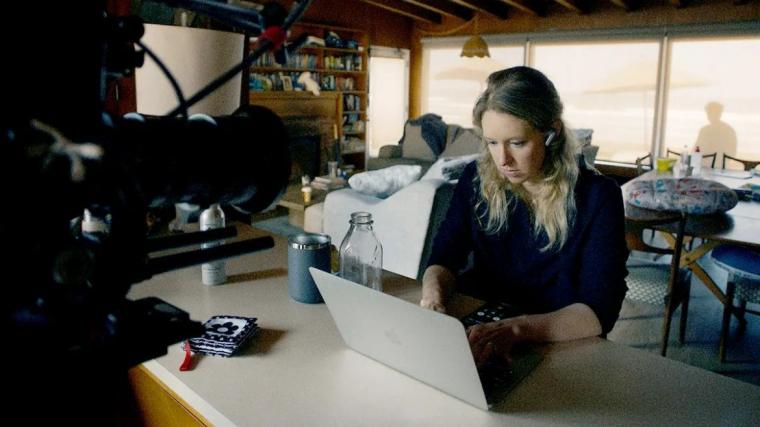
Without giving away too many specifics, the movie's unofficial part two takes place some time after the captured events in Del Mar, with Holmes serving her sentence in a minimum-security prison in Bryan, Texas, and Evans – who has relocated to the state to be closer to her – raising their two children on his own. Fielder is still in the picture, still searching for answers he's increasingly sure he'll never get. And that's when YCSE drops its bombshell: the arrival of a new figure to immeasurably complicate, enrich, and potentially shed some light on everything we've thus-far witnessed. This might be the most brazen, delicious narrative upending I've experienced in a decade or more, and I likely wasn't alone in my shock. At my weekend screening in Davenport's Last Picture House, nearby patrons didn't gasp so much as share an escalating vocal inhale, one that culminated in a giddy “WTF?!” laugh of recognition and expectation.
Suffice it to say that everything grows more complex, entangled, and unknowable with the appearance of this late-stage participant: the enigma of Elizabeth Holmes; the motives of Billy Evans; the distraught confusion of Nathan Fielder; the potential culpability of A24 itself. And then there's the “us” of it all to consider. Why, more than a decade after the Wall Street Journal's 2015 exposé led to Holmes' and Theranos' downfall, are we still so fascinated by this story? What are we hoping to learn that, in all likelihood, we won't ever learn? How Holmes did it? Why she did it? If she even did do it? What would any of those revelations mean, and why – now, still – would they matter?
Maybe the answer is as simple as our collective need for, at long last, The Truth – a deep-seated desire to solve the Elizabeth Holmes puzzle in the way some still cling to theories, conspiratorial or otherwise, regarding JFK's assassination and the moon landing and 9/11. What You Can See Everything demonstrates, perhaps better (and more enjoyably) than any other movie I can name, is how futile those attempts at “truthful” closure truly are. Late in the film, we watch Fielder watching someone watching someone watching someone who, flabbergastingly, is the very same person Fielder is watching. We'll never know, as a certainty, what any of these people are honestly seeing. But there's something lovely and touching, something deeply human, about our need to know. Fielder and Oppenheim don't argue that the pursuit of truth is worthless – just that we have to agree to live with, and make peace with, the uncertainty of it all. I left YCSE both wiped about and staggeringly elated. Hands down, it's the movie event of the year.

MUSK
I don't like looking at Elon Musk. I don't like listening to him speak. I don't like reading his opinions on world events or our tech-centric future or the need to colonize Mars or how Christopher Nolan's Odyssey sucks because the director dared to cast a black actor as Helen of Troy and a trans actor as Sinon. But for nearly four hours (including its 10-minute intermission), I was absolutely riveted by Alex Gibney's Musk, a stunningly expansive documentary that manages the miraculous feat of not being boring for a minute.
It should be stated up front that, even at 235 minutes, this is hardly an even-sided take on Elon's history, accomplishments, personal and professional detours, and current position as the wealthiest human being on the planet. Nor, for my money, should it be. Three years ago, before Gibney's film was anywhere near completion, Musk already deemed the uncompleted project a “hit job” on his rebranded Twitter site X, and has since gone on to call the filmmaker “a shill for the far left,” a “tinfoil-hat crackpot,” and, most simply and memorably, “a douche.” (Gibney's retort on X? “Douché.”) So no, Gibney doesn't go out of his way to enlist, as talking heads for Musk, anyone prone to stand up for the poor, blighted trillionaire. He doesn't need to, because Gibney's doc provides ample evidence of the many, many American citizens who have revered him (many of whom likely continue to) through the years. They're the screaming, fanatical fans at Elon's product launches and rally appearances. They're Joe Rogan and Tucker Carlson and a 2021 studio audience for SNL. They're the current president of the United States when he and Elon aren't trading threats and pissy insults. As the widespread public adoration has made clear, the world's second-most-influential adult baby, if not the most-influential, has plenty of admirers. But how, Gibney asks, did this happen, and why?
The “why,” unfortunately, is still a little hazy in Gibney's four-hour portrait, maybe because the filmmaker himself hasn't reached a conclusion he can live with. A healthy percentage of Americans worship wealth and power, obviously. And though it might send a chill through the spines of those few viewers shelling out money for Musk – after 10 weeks (this past weekend being its official national roll-out), Gibney's doc looks unlikely to ever crack $1 million domestic – the movie's subject continues to enjoy devotion to a nearly acolytic degree. Gibney can't, or at least doesn't, try to explain this beyond the generally agreed notion that a majority of Americans are lemmings who will happily follow an über-wealthy blowhard over whichever cliff he tells us to.
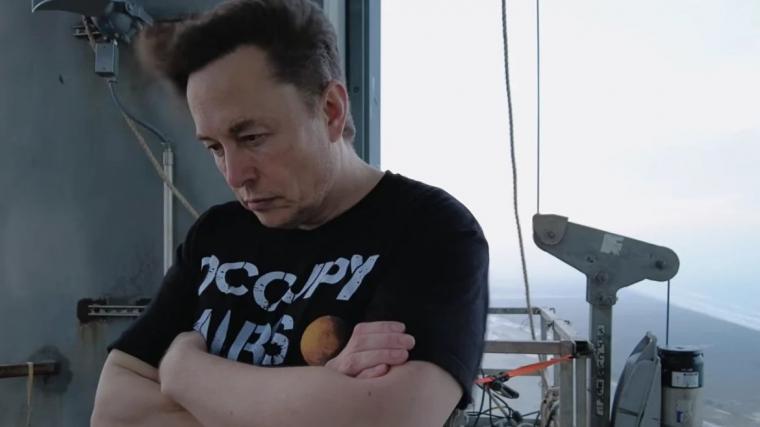
The “how” behind Elon's rise to world (financial) supremacy is explored with far more thoroughness, and even though Musk himself would no doubt never admit it, there are moments here in which we're actively invited to root for the guy – and it's surprisingly easy to do. You almost can't help but be disappointed for Elon when, one after another, his early SpaceX experiments explode, nor silently cheer when the reusable rockets make astoundingly safe and graceful returns to earth; the first time I saw one of these miraculous landings in Musk, my grin was a mile wide and I was thisclose to applauding. (And certainly could've without being a distraction to others; at my 9:50 a.m. Moline screening this past Friday, I was the only one there.) Gibney, however, lays his motivational cards on the table from the outset, explaining in voice-over that because Elon refused to sit down for a proper interview, he and his creative team came up with an alternative for this noted champion of AI: an AI replica of Elon Musk, admittedly looking quite suave (better than he usually does), with an enviable tan in a black leather jacket, repeating previously recorded Elon sentiments directly to the camera. While it's not the mind-f--- that the You Can See Everything presentation is, it's awfully damned close.
It also fits neatly into Elon's stated perception that we're just living in a simulation fashioned by beings of higher consciousness; that we're all, in essence, in a video game. Gibney takes this conceit and positively runs with it, demonstrating Elon's acquisition of power in first-person-shooter scenarios that find “Elon” casually annihilating passersby for cash and accruing enormous wealth with no regard for the social, personal, political, or environmental ramifications. If this is all a video game, after all, who really gets hurt? Two mothers of some of Musk's 14 (known) children, on-screen interviewees Justine Musk and Ashley St. Clair, certainly did, as did dozens of on-the-record former business partners and allies and friends and foes. And as Gibney's fascinating, maddening doc delves deeply into Tesla and SpaceX and Twitter X and Trump's re-election campaign and DOGE, Musk, much like You Can See Everything, takes on the qualities of a particularly unsettling horror movie. Yet this film boasts no humanistic safety net or path toward redemption. Not for nothing is the image of Earth exploding incorporated at least three times. This, Gibney argues, is what unchecked power such as Elon's is guiding us toward – and as a nightmarish coda, he persuades us that it's not a Game Over the rocket-owning trillionaire would have a problem with.
For reviews of Street Fighter, Sense & Sensibility, and Whalefall, visit “MMAsters of the Universe.”