
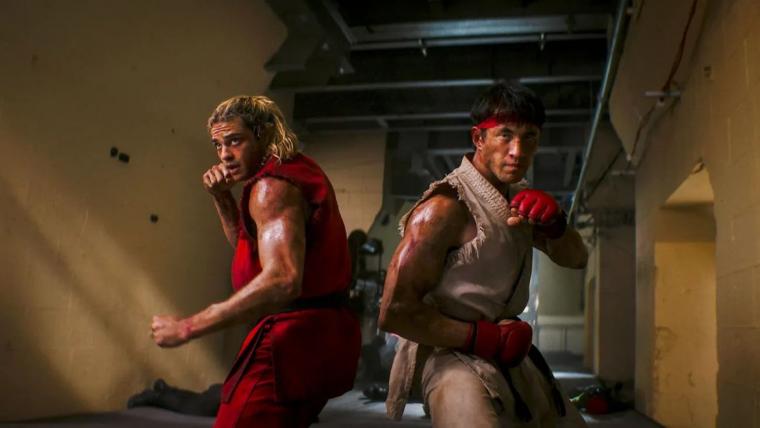
Noah Centineo and Andrew Koji in Street Fighter
STREET FIGHTER
Because I go to the movies a lot and consequently see the same trailers more often than I want to, I generally make a habit of arriving for screenings 10 minutes after their scheduled start times, giving myself a better chance of not seeing the same preview a million times over. I consequently arrived for this past Saturday's 10 a.m. showing of Street Fighter promptly at 10:10, and I kid you not, folks: 10 movie trailers in a row, not counting the requisite ad for Cinemark, a Halloween-themed push for Fanta sodas, and an Amazon-delivery commercial designed as a fight scene from Amazon Prime's The Boys.
In no particular order, the upcoming releases being promoted were: the latest Jumanji with Kevin Hart and The Rock; Robert Eggers' black-and-white monster flick Werwulf; the Johnny Depp Christmas Carol re-do Ebenezer; an aquatic sci-fi titled Above the Below; the late-January melodrama The Rescue; the National Geographic doc Everest: The Other Side; the animated titles Hexed and Wildwood; and a pair of critically lauded autumnal outings, Wild Horse Nine and Club Kid, whose previous R-rated previews were apparently deemed inappropriate for the PG-13 video-game adaptation we were about to see.
First off: Seriously?! Ten trailers? And that's with me showing up 10 minutes “late”! Were there others I somehow missed before taking my seat? Second off: What could those 10 chosen previews possibly have in common with Street Fighter? We all know the drill regarding the cineplex pre-show: If you're at a family-friendly outing, you'll see family-friendly teasers; a horror film will be preceded by horror teasers; et cetera. By the time director/co-writer Kitao Sakurai's martial-arts action comedy ended, though, I weirdly, and not unhappily, understood the inclusion of each one of those 10 chosen ads. The new Jumanji because we were attending a broad action comedy. Werwulf because Sakurai's film had black-and-white scenes. Ebenezer because extensive facial prosthetics were on display. Above the Below because of how often Sakurai's characters were photographed while wet. The Rescue because of the occasional maudlin sentimentality. Everest because of the impossible mission and brotherly bond. Hexed and Wildwood because of the many scenes rendered via animation. And Wild Horse Nine and Club Kid? The former because this über-violent spectacle oftentimes feels like something R-rated being shoehorned (like that WHN teaser) into a PG-13 box. And the latter – Club Kid being a dramatic comedy about a gay man befriending the child he didn't know he fathered – because Street Fighter itself is routinely super-gay.

This isn't meant pejoratively or as any kind of rude critique. Far from it. In truth, the ideal trailer for Sakurai's take on the Capcom video-game series (its first semi-famous stab starring Jean-Claude Van Damme in 1994) would've been this past June's Masters of the Universe, a similarly tongue-in-cheek adaptation of long-standing commercial IP with built-in homoeroticism. In that film, even Jared Leto's Skeletor couldn't restrain himself from salivating at the brawny figure cut by Nicholas Galatzine's He-Man, and Street Fighter appears to double-down on the conceit. Until the movie becomes buried in prototypical action nonsense and noise in its final half-hour, and even after that, I don't think a single scene involving at least two men transpires without some sort of barely-coded or fully announced subtext.
Best buds Ken Masters (dim bulb extraordinaire Noah Centineo) and Dan Hibiki (Andrew Schulz) sleep while spooning, Dan clad only in his underwear. Cody Rhodes' flat-topped Guile denigrates Orville Peck's lithe, masked Vega by saying “This isn't a beauty contest!” before wistfully adding, “But if it were … !” Curtis “50 Cent” Jackson's Balrog shouts that he's looking for “fresh meat to beat.” The ideally cast Andrew Koji's Ryu and Olivier Richters' “piledriver” Zangief have a mano a mano in a steam-filled sauna wearing towels, Zangief losing his halfway through. (It's like a Capcon take on David Cronenberg's Eastern Promises.) Ken weeps over the presumed dead body of his beloved Ryu and sings him a love song while Dan explains to an onlooker that “male friendships are … complicated.” The delectable David Dastmalchian, leering and sniffing as M. Bison, frequently goes full Jared Leto, inviting Ryu to dine on snails like Laurence Olivier teasing Tony Curtis in that initially cut scene from Spartacus. There are dozens of examples of this sort of eyebrow-raising peekaboo here, and as someone who instinctively loves it when Gen X and post-Gen X viewers see their cherished childhood fetish objects re-created as things deservedly ripe for good-natured laughs at the expense of alpha bros, I had way more fun than I expected at Street Fighter.
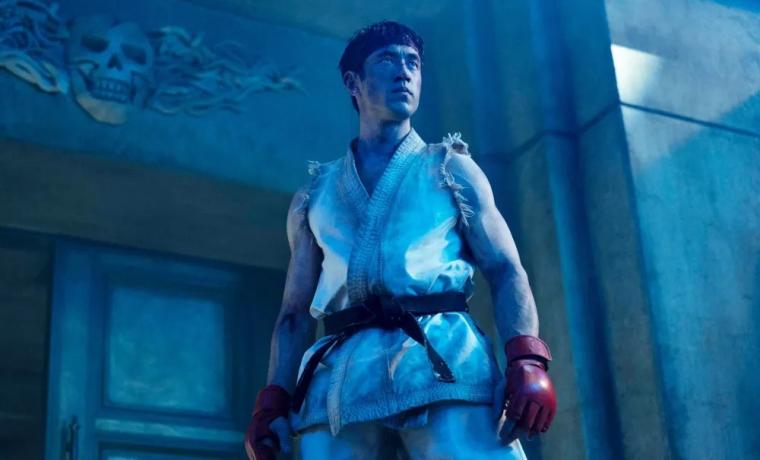
If it seems I've gone inordinately long about the movie without giving any indication of its plot, that's by design. Because really, who cares? Adoptive brothers Ken and Ryu have a falling out after a cataclysmic fight in 1987 Japan in which their mentor was killed. Six years later, they're reunited as competitors in a rigged World Warrior tournament. Dastmalchian's villainous Bison is planning to steal the life force, or something, from the victor. The evil deity Akuma (Joe “Roman Reigns” Anoa'i) plans to annihilate the victor. There's an investigative reporter (Callina Liang, topnotch as Chun-Li) masquerading as a Bison aide-de-camp. There's a bellowing World Warrior announcer who, because he's played by Eric André, made me laugh a couple times. There are, no doubt, tons of Easter eggs for players of the Street Fighter games … but as I've never myself played it, you're on your own as far as that's concerned.
For the most part, as you'd expect, what we primarily get is fighting, and I gotta say, the fights are pretty great. Excepting Ryu's face-offs with a CGI Jason Momoa as some kind of electrified Hulk, the combat is kept smartly (if gravity-defyingly) human-scale, Sakurai's action choreography and the editing (by James Thomas and Delaney Del Vecchio) doing an overall superb job of replicating a live-action video game. Because my eyes tend to glaze over at even the most thrillingly rendered martial-arts sequences, the two-hour Street Fighter lasted roughly 30 minutes longer than I would've preferred, and for a plot this simple (T. J. Fixman is the co-screenwriter), the details were perhaps more epically motivated than necessary. Yet as goofy and overstuffed as it is, Sakurai's offering is quick-witted, funny, and blessedly aware of both its inherent silliness and undisguised subversion. To quote the Flintstones theme song, you'll have a gay old time.

SENSE & SENSIBILITY
Because Ang Lee's 1995 rendition of Sense & Sensibility is so beloved by so many, myself very much included, I had my guard up toward director Georgia Oakley's new Jane Austen adaptation from moment one. It probably took all of 10 minutes for that barrier to come crashing down. I doubt that Oakley's and screenwriter Diana Reid's take will ever be considered iconic the way Lee's 31-year-old achievement is. Not every film is lucky enough to be the beneficiary of Emma Thompson's screenwriting wit and to provide a cinematic breakthrough for a talent as sublime as Kate Winslet (despite Esmé Creed-Miles, assuming Winslet's role as the impetuous Marianne, being a major find herself). Yet right from the start, this S&S distinguishes itself as an intensely worthy companion piece: soulful, respectful, earthy, funny, and swooningly romantic. In a few specific areas, it even manages to improve upon the '95 Oscar winner, which I would've considered a mildly heretical statement before seeing the film and realizing it was true.
For fellow lovers of the Lee, my late-teen memories of reading Austen's novel being no help in this regard, everything here is nearly exactly as you remember. We're introduced to the newly homeless and financially unstable Dashwoods following the patriarch's passing: mother Mrs. Dashwood (Catríona Balfe), eldest daughter Elinor (Daisy Edgar-Jones), middle daughter Marianne (Creed-Miles), and youngest daughter Margaret (Bodhi Rae Breathnach), Elinor significantly younger than in '95 and Margaret a few years older. Potential life partners Edward Ferrars (George MacKay), Colonel Brandon (Herbert Nordrum), and John Willoughby (Frank Dillane) show up, as does the delightfully loud busybody matchmaker Mrs. Jennings (Fiona Shaw at her most joyously boisterous). Austen's remarkable assemblage of significant fringe characters is back: Sir John Middleton (Turlough Convery); Lady Middleton (Chloe Pirrie); John Dashwood (Tom Brooke); Fanny Dashwood (Stacy Martin); Lucy Steele (Ceara Coveney); Mrs. Palmer (Bethany Slater); and Mr. Palmer (Eliot Sumner). And story-wise, Oakley's and Reid's Sense & Sensibility follows Lee's and Thompson's progression to a T, barring Reid's inclusion of a Brandon/Willoughby duel merely referenced in Austen's book (and ignored by Thompson) and a climactic romantic gesture that has more in common with modern-day rom-coms than 19th-century literature. The moment is essentially a corseted race through an airport terminal, and harmless though it is, it's one of this adaptation's few overt mistakes.
In all honesty, and not just due to my fondness for Thompson's script, I could've also done without the duel, which, as presented, seems a little unfair given that the challenged participant is clearly drunk. Although I admire the nontraditional casting, Sumner feels temperamentally wrong, and way too young, for Mr. Palmer. (As in Netflix's limited series Ripley, it seems as though Sting's son was hired primarily to make comparisons to previous portrayers of Sumner's roles impossible, Philip Seymour Hoffman having played Freddie Miles in The Talented Mr. Ripley and Hugh Laurie having been Mr. Palmer for Ang Lee.) Meanwhile, despite giving the part her all and occasionally emerging as genuinely touching, Edgar-Jones' facial expressions are unnecessarily active, even a little broad, leaving us – and leaving Marianne, who routinely references her sister's unreadability – with little question as to what this theoetically poker-faced Dashwood is thinking and feeling. Edgar-Jones' Eleanor might've unwittingly revealed more had she demonstrably shown less.

That, I'm delighted to report, is where my complaints end, and among myriad compliments this Sense & Sensibility is due, Diana Reid deserves a bunch of 'em. Although Austen, of course, wrote reams of clever and amusing dialogue, this adaptation isn't as sporadically hilarious as Thompson's. Reid's script does, however, clarify the many tangled familial relationships with more ease and instant understanding than Thompson's, and without being overly expository. Her words augmenting Oakley's images, she also digs at the terrible financial burden newly placed on the Dashwoods, and without being pushy about it, makes evident how essential marriage is for the four women to have a fighting chance at re-found prosperity. Best of all, Reid gives the blossoming romance between Elinor and Edward far more room to breathe; you don't feel, as I generally did in '95, that these desperately shy, yearning figures are matched simply because they're being played by the most famous actors on-screen. (It helps that Edgar-Jones does her most heartfelt work in these segments, and that MacKay appears infinitely more comfortable in Edward's skin than adorable, out-of-his-element Hugh Grant ever did.) Reid also allows Colonel Brandon to be less of a consolation prize. His ardor for Marianne, like Alan Rickman's back in the day, is palpable, yet Reid's rendition allows Marianne more time to recognize that truth for herself, and for her to discover that, per rom-com tradition, what she was looking for had been in front of her all along. Elinor learns to embrace her sensibility, and Marianne finds some sense.
Oakley's directorial grace proves an ideal match for Reid's clear, honest rendering of the Dashwoods' plight. Despite the occasional shots of bucolic splendor, this is the 19th-century England countryside as cold, dirty, and largely unwelcoming. When Elinor and Marianne, traveling with Mrs. Jennings, get their first faraway view of London, it felt perfectly reasonable for the wondrous vista to be (evidently) a masquerading-as-real matte painting à la Moulin Rouge! – London itself, for the young women, being too beautiful, especially in comparison to their countryside dwelling, to be believed. Oakley is alive to atmosphere: the interior humidity of a crowded ballroom; the chill in the Dashwoods' rock-floored Devonshire lodgings; the gentle breeze as Margaret lounges on a tree swing. She also proves excellent with actors, and beyond the occasional missteps in Edgar-Jones' and Sumner's portrayals, I particularly marveled at the emotional truth, and the overripe-when-necessary work, delivered by Creed-Miles, MacKay, Nordrum, Dillane, Martin, and Shaw. Like a firstborn child, Ang Lee's version will never not be my favorite. (I'm correct in making that analogy, right, Mom? Ummm … right?!) Yet this Sense & Sensibility is lovely and wise and wholly satisfying, and makes moot every argument against its very existence. Did we need this film? Perhaps not. Does it deserve to be seen? Absolutely.
WHALEFALL
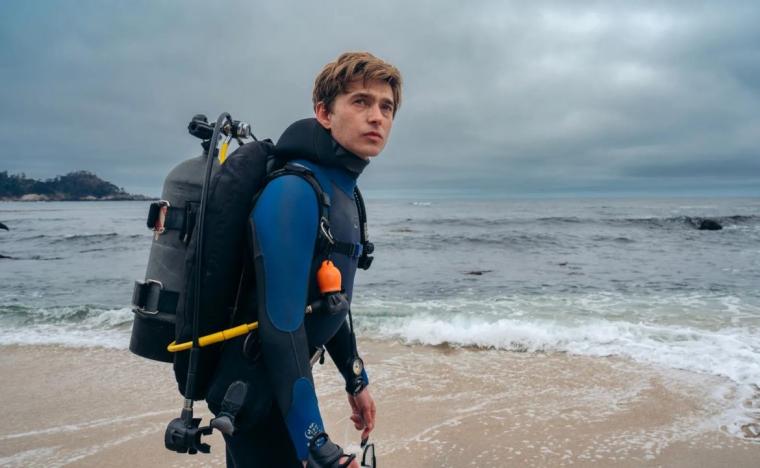
What if, as a teenage boy, your Daddy Issues both figuratively and literally swallowed you whole? That's the overriding question in director/co-writer Brian Duffield's Whalefall, an action thriller in which Austin Abrams' Jay Gardiner finds himself in the stomach of an enormous sperm whale, and is forced to recognize and accept the tough-love teachings of his estranged, deceased dad – Josh Brolin's Mitt – to get him out. The trailers for this thing preyed on a lot of my most basic fears: the open water; living things prospering in the open water; claustrophobic surroundings; having hard-ass Josh Brolin as my dad. As a film experience, though, Duffield's is sadly easy to shake off.
What gets Jay into his oceanic pickle is his need – the reasons initially unknown even to himself – to extract the remains of his father, whose cancer diagnosis led to him committing suicide by strapping his body with weights and plunging into the Pacific. Instead of finding Mitt's body, Jay finds himself entangled in the tentacles of a squid that's trying to evade the aforementioned whale, who, in turn, devours both the squid and Jay, leaving the teen alive but engulfed in the first of three stomach compartments. As you might imagine, Jay's new whereabouts are gross, and kudos to Duffield's production-design team for being so thoroughly meticulous about a locale we viewers would go out of our way to avoid. Every inch of the creature's interior is squishy and repellent when it's not fatally acidic, and with the oxygen levels on the teen's scuba gear giving him less than an hour to live, it's inconceivable that Jay will be able to extract himself from this behemoth, and make it to shore, before time runs out.
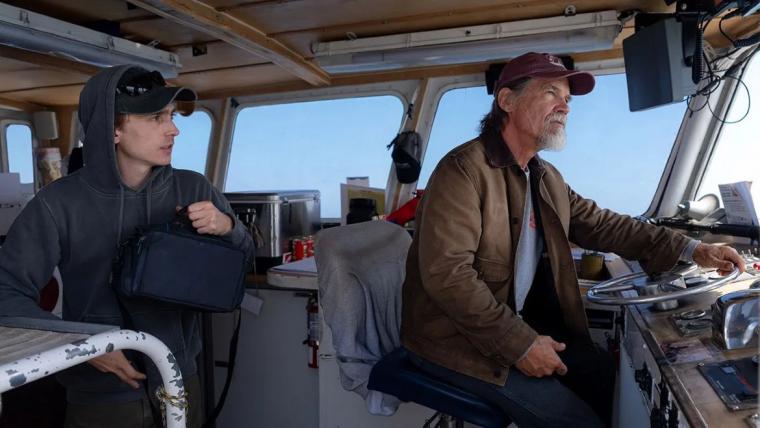
Thank God for flashbacks, huh? Because it turns out that for every new crisis Jay encounters, he has a handy remembrance of important survival lessons sea-faring Mitt taught him as a youth: breathing techniques; packing the proper gear; application of found objects. And as Jay resolutely employs this knowledge, Whalefall stops being action-adventure fun and starts to become a rather heavy-handed, and obviously literary, metaphor. The film was co-written by Daniel Kraus, who wrote the 2023 book the film is adapted from, and it's impossible to ignore the movie's literary origins; the script plays exactly like a novel's first-person account awkwardly translated to third-person cinema. Jay makes statements out loud that would almost certainly have been mere thoughts in print, and a specific conceit that effectively turns Jay's dad into the whale – complete with kindly, sensible voice-over advice – would be laughable if it weren't presented, here, with such off-putting earnestness. Every time we're legitimately caught up in the procedural nuts-and-bolts of Jay's escape plan, there's another sentimental reverie to the kid enduring his Quint-like dad's brutal Tough Love, and all narrative tension evaporates.
Abrams certainly makes this mostly draining experience more worthwhile, and I'm beginning the think the actor has an almost chameleonic talent. He reportedly shot Duffield's feature months before Resident Evil and a full year-plus after Weapons, and yet he looks, and acts, years younger here than he did in either of those films; had I not seen the Creggers, I would've totally believed the 30-year-old to be a late-stage teenager. Abrams' face is open and innocent, his too-rarely-seen smile is genuine, and he responds to harrowing incidents, as he did in Resident Evil, the way many of us no doubt would: He shrieks his lungs out. It's hardly Abrams' fault that, given Jay's underwater breathing apparatus, only about half his words are comprehensible. He's still empathetic and affecting, and in truth, Whalefall couldn't have been released at a better time. Because not only do we want Jay to survive, we want Austin Abrams to survive, if only to ease the pain of Resident Evil's gorgeously nihilistic finale. While that's not reason enough to catch this unexceptional fish expedition, I do admire the bait.
For reviews of You Can See Everything and Musk, visit “Holmes and Sherlock.”