
WEST DES MOINES, IOWA (August 25, 2026) — Whether they studied osteopathic medicine, public health, or biomedical sciences at 722 Sixth Avenue, 3200 Grand Avenue or the new campus at 8025 Grand Avenue, graduates of Des Moines University Medicine and Health Sciences share one thing in common: the degrees they earned prepared them to care, to lead and to serve.
It's a physical therapist helping patients regain balance and confidence after the disorienting effects of dizziness.
It's a plastic surgeon restoring form, function and a sense of self.
It's an occupational therapy graduate just beginning her career, working toward becoming a Certified Hand Therapist.
Each path is distinct, and each calling is deeply personal. At DMU, those callings are first shaped in the classroom and continue in clinics, hospitals and communities near and far.
Through our Life After DMU series, we celebrate ten alumni who exemplify the many ways a DMU degree can make a difference.
Life of an. . . Anatomist: Where Science Meets Humanity
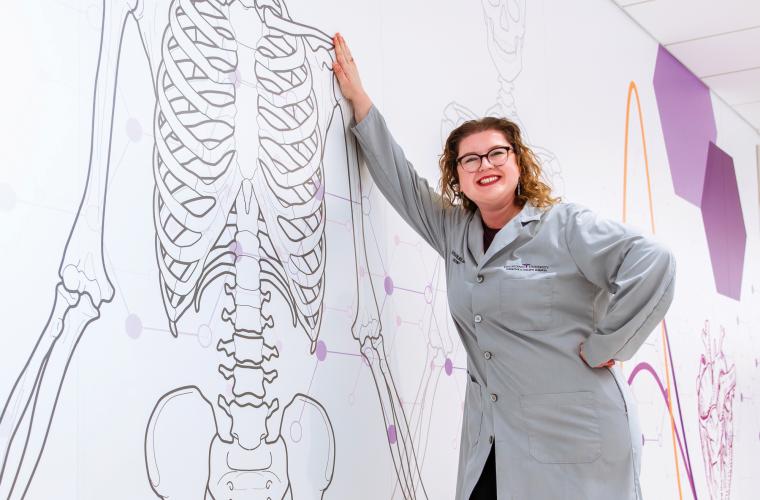
Katie Bejes MSA ('20) still remembers the moment she first touched a gluteus maximus, the body's largest and heaviest muscle, in an Indiana University anatomy lab.
"This is so cool," she recalls thinking. "I need to know more."
To do so, Bejes enrolled in the Master of Science in Anatomy program at DMU. When she graduated in May 2020, she secured a position as a medicolegal death investigator with the Iowa Office of the State Medical Examiner, helping investigate suspicious, unexpected, violent, or unattended deaths to determine the cause of death.
Bejes saw her role as a compassionate liaison between the state and the families of the deceased. She collected medical records, police reports, and EMS reports and gathered background from the family while also keeping them informed. She worked with funeral homes after the autopsy as well.
Some cases Bejes was assigned were homicides, while others involved children or elder abuse. Those weighed especially heavily, but many of the cases she worked on ultimately stemmed from medical circumstances, like heart attacks. She quickly found that being able to explain what a heart attack is and why it happens to families was paramount to her role.
"Everybody grieves differently, so I learned a lot about professionalism and how to talk to people in a state of grief," Bejes says.
"I learned the power of silence."
One of her favorite parts of working as a death investigator was knowing that the stories behind her cases didn't end there.
"Based on our findings, we could help change laws," Bejes explains.
For example, the requirement for drain covers at the bottom of swimming pools emerged after death investigations revealed people had become trapped by their hair or swimsuits in uncovered drains. Iowa's hands-free law, which prohibits drivers from using electronic devices while driving unless they're in a hands-free setting, was also shaped by insights gained through death investigations.
Today, Bejes is back at DMU as an anatomy lab specialist, essentially running the cadaver lab, or, as Bejes calls it, the donor lab.
An important part of her role is preparing students for their first time in the lab.
"A lot of people have never seen a dead body before, so I'm sensitive to that, especially if they've had a recent loss," Bejes says.
"We bring the students in, let them get comfortable and give them a moment to process. And I also keep apple juice and granola bars on hand just in case."
One thing Bejes is focused on is expanding opportunities for people to experience a cadaver lab, because there are so few. Recently, she helped bring in EMS professionals and taught neck anatomy, even having them palpate an actual larynx to show how small it is.
"These are skills they use in real life, like intubation, so being able to see and feel the anatomy makes a big impact," Bejes says.
At the heart of Bejes' career, whether speaking with grieving families or helping a student determine the difference between fascia and a nerve, is simply being human.
"I'm a big proponent of mental health. I've had my own struggles with depression and anxiety, so I try to check in on the students," she says. "I remember when I was in grad school, I used to ask myself, 'When is this going to be worth it?' And now I can say, it is. I made it."
This story was originally published in the August 2026 issue of DMU Magazine.
Located in West Des Moines, part of Iowa's capital metro, Des Moines University Medicine and Health Sciences offers graduate-level professional-degree programs in anatomy, biomedical sciences, health-care administration, medical science, occupational therapy, osteopathic medicine, physical therapy, physician-assistant studies, podiatric medicine, and public health. Founded in 1898, the institution offers superior academics in a collaborative environment. DMU students' scores on national examinations, pass-rates on board certifications, and match-rates for medical residency programs are consistently higher than national averages and rates at peer institutions.