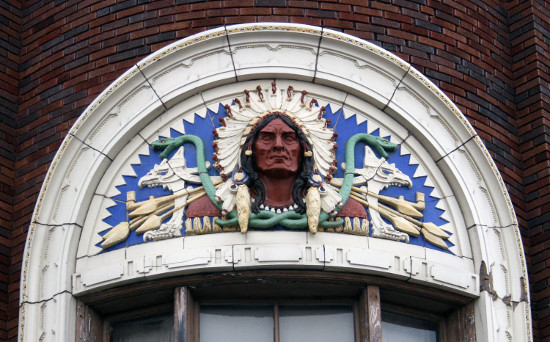
At the corner of Third Avenue and 19th Street in the Rock Island District is a glazed terra-cotta bust of an American Indian wearing a war bonnet that encircles his head, almost like the traditional painting of a halo. Arrows, peace pipes, and entwined snakes are also included in the symmetrical composition. This 10-foot-wide relief is placed above the second-story window on the rounded corner of the Fort Armstrong Theatre building.
Though the artwork is ornate, the dominant central face gives it a strong point of emphasis. The angular structure of the face and surrounding triangular patterns are counterbalanced by the overarching half-circle and circular shapes radiating from the composition's center.
The decorative patterns around the other second-floor windows and the building's outline are also composed of these geometric shapes and Native American symbols. The ivory-, blue-, yellow-, red-, and green-colored glaze stands out against the theatre's dark-red brick exterior.
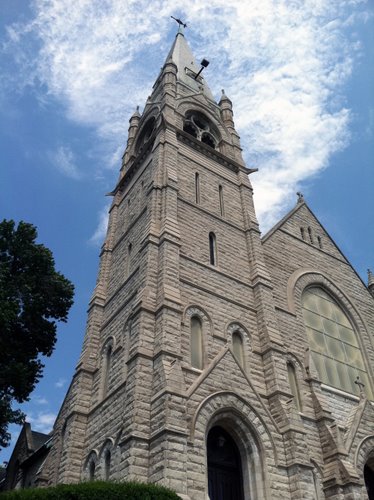 When Sacred Heart Cathedral (at the corner of Iowa and 10th streets in Davenport) was completed in 1891, its bell tower and spire was the tallest structure in the Quad Cities. Soaring majestically above the surrounding trees and neighborhood, its approximate height of 160 feet seemed even greater because of its placement at the top of a steep hill near the crest of the bluff overlooking the Mississippi.
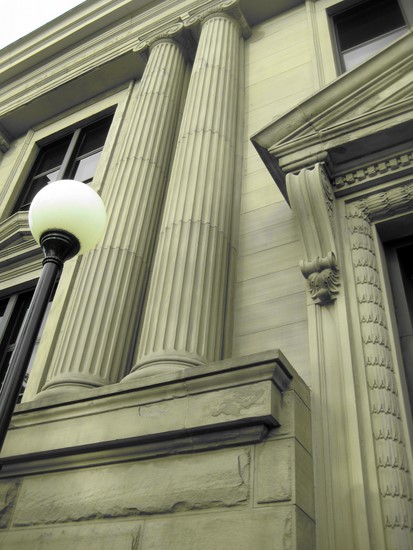 More than a century separates the opening dates of the most recent and the oldest public-library buildings in the Quad Cities. The differences between these buildings reflect our changing relationship to the environment, and their architecture reflects the evolution of the library from a symbol of culture to a community center.