
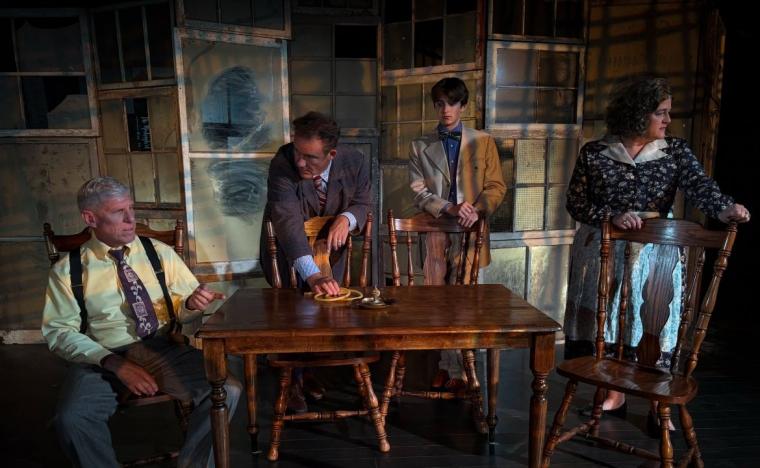
James Driscoll, Benjamin David, Jack Carslake, and Emmalee Hillburn in Death of a Salesman
There are some scripts that can be like pulling teeth when not done right. Thankfully, no orthodontist is needed for director Tristan Tapscott's powerful production of Arthur Miller’s Death of a Salesman.
Considered by many to be one of the great American plays written by one of the great American playwrights, Salesman tells the story of Willy Loman (an imperial James Driscoll). A traveling salesman, he has bills to pay and a family to provide for, and those are often the order in which precedence is taken in his mind. Indeed, his mind is where much of the play takes place. Not a traditional memory play in the vein of Tennessee Williams, Miller's drama instead explores the immediacy of the past crashing into the present. Something adverse will affect Willy in the now, which will make him retreat into the confines of his mind, and when his memories prove cruel and unwelcoming, he slips even further into more distant memories. It’s a dizzying storytelling technique that places the audience squarely in the shoes of someone who is losing their grip on reality.
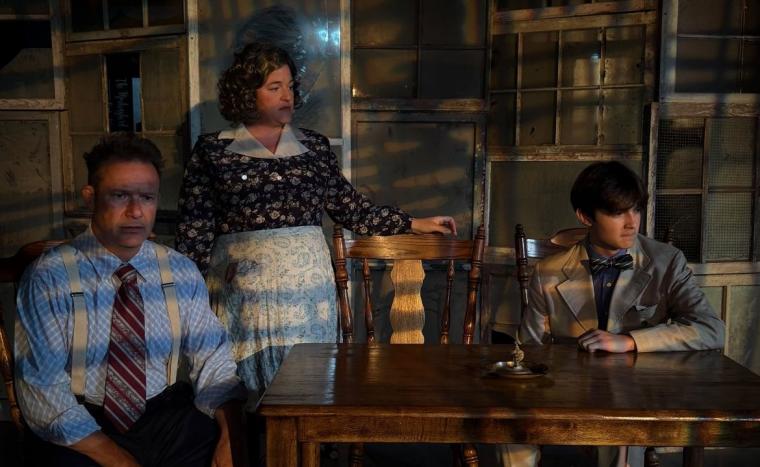
Which is the big problem. Willy Loman has gotten into a habit of driving his car off the road. He wanders around the neighborhood, talking to himself at full volume. He has started having conversations with people only he can see. His family is at a loss as to how to deal with him. His wife Linda (Emmalee Hillburn) placates him and cleans up after his messes. His youngest son Happy (Jack Carslake) feeds into his delusions. And his oldest son Biff (Benjamin David) left the state only to return to try and make things right.
I should probably note that when I was in high school, Death of a Salesman was my favorite play. Yes, I was a really weird teenager. (My wife prefers the adjective “pretentious.”) Had you asked me at the time why it was my favorite, I probably couldn’t have given you an answer of any substance. However, watching it now as an adult, I see what struck a chord with teenage me. The Loman family is not unlike my own; not unlike many families I’ve known. Willy Loman is not a certain man but a certain type of man, and you likely won’t be hard-pressed to connect his behavior with that of someone from your own life.
At Friday's Salesman performance, I noticed how remarkably (and frighteningly) well Miller's tremendous script has aged. The Loman family bemoans apartment complexes supplanting family homes, the amount and frequency of bills they have to pay, and, in a throwaway line, how cruel it is that products are only designed to last as long as the payment plan does. That this 77-year-old play can still speak to us today, in such a specific way, is as amazing as it is horrifying.
If much of the show's strength comes from the script, the rest (and there’s a substantial amount of “the rest” to be had) comes from the ensemble cast and Tapscott's clever direction. Hillburn, Carslake, and David are exceptional at highlighting the interpersonal dynamics of a dysfunctional family. The way the brothers treat one another is not the same when their mom is in the room, which is different yet from when their father is in the room, and of course, the relationship between husband and wife shifts when the kids aren’t around. And they all also do a great job of building the escalating stakes and tension. The core actors are also supported by an excellent troupe of supporting performers, particularly the elegant Sophia Kilburg, the mysterious Dana Moss-Petersen, and the perfectly cast Renaud Haymon as Loman neighbor Charley.
But this production would be nothing without its Salesman, and Driscoll, here, is exceptional. What could be considered mundane conversations are turned into matters of life or death, and you can feel Willy Loman trying to will dreams into reality. At turns powerful and pathetic, Driscoll masterfully navigates the high and lows of American theatre’s most tragic hero. I often found myself holding my breath as he and David would start to snipe at one another, building in intensity and fervor.
There were some issues on Friday night with the sound design, which managed to swing between being too loud and too quiet. And there was a bit of a lull during the show's opening scenes. Whether it could be chalked up to low energy or the direction's pacing is hard to say, but this Salesman had a slow start. As both actors and audience settled into the story, however, the time absolutely flew by, and when I left the theatre, I was shocked to see that nearly three hours had passed. Yes, the show is long, but it never feels that way.
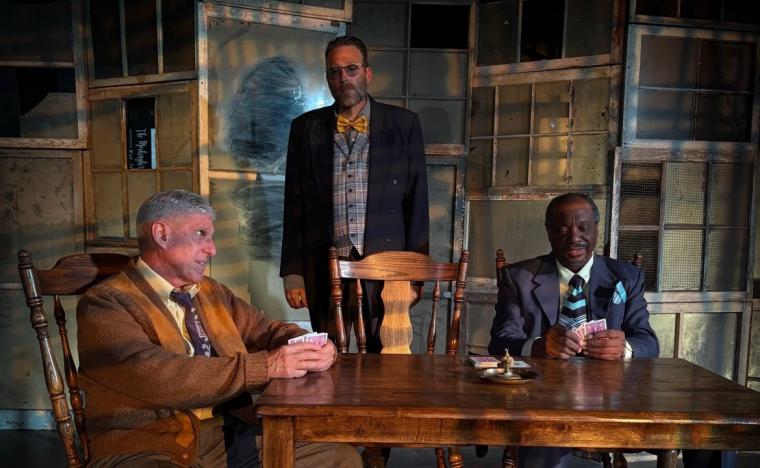
Tapscott's scenic design is superb: a series of dusty windows that look like they were lifted from some long-forgotten farm. Often, people from Willy’s memories will appear, suddenly and startlingly, in these windows, signaling yet another shift into the past. Savannah Bay Strandin's costumes were also delightful, with some eccentric touches helping to distinguish reality from fiction.
Death of a Salesman tells an all-too-American story, one of a distant and ill-remembered past being used as a rationale for the unforeseeable future. Plans are made then dashed, and illusion replaces reality. It’s not an easy watch, but it is a deeply compelling one.
The Mockingbird on Main's Death of a Salesman runs at the Black Hawk College theatre (6600 34th Avenue, Building 1, Room 308, Moline IL) through August 29, and more information and tickets are available by visiting Facebook.com/TheMockingbirdOnMain.