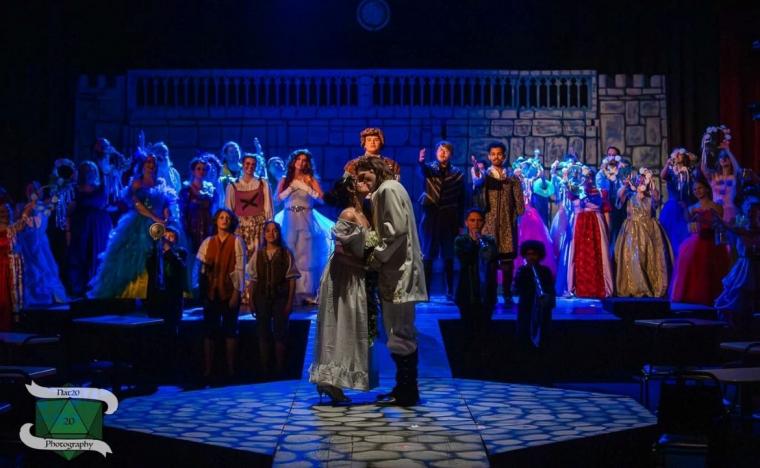
the ensemble of Rodgers & Hammerstein's Cinderella (photo by Nat20 Photography)
Is there a musical score that utilizes more scripts by different writers than Rodgers & Hammerstein's Cinderella? I count at least a dozen versions on TV and stage, from 1957 (the original with Hammerstein's book, starring Julie Andrews) to Broadway’s 2013 production (its script by Douglas Carter Beane). The plots, characters, and names differ considerably; even the criminally catchy score varies, with some numbers cut and more – trunk songs from Rodgers’ other shows – added. I disliked the original script’s digressions into irrelevant, vaudeville-style comedy. It was the 1965 version starring Lesley Ann Warren, rerun on TV in the '60s and '70s, that ensnared me (and taught me all the songs). The only funny parts in that script, though, were provided by the stepsisters.
The Spotlight Theatre’s current offering is the 2013 Cinderella, which has all the memorable songs and just the right amount of appealing humor. This script has some killer one-liners – precision strikes that hit, make their comedic explosion, then let the dust settle quickly so we can get back to the story. And I thoroughly enjoyed Friday’s opening-night performance, with director Sarah Greim, music director Christine Rogers, and choreographer Michelle Kabel wrangling a large, talented cast with terrific voices, and the show's crew contributing to the magic.
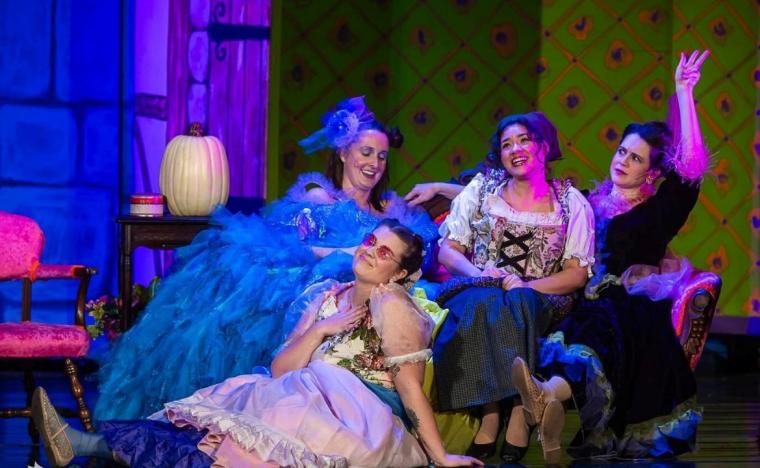
In this iteration, most of the characters’ names are French, likely in honor of Charles Perrault's famous 1697 version of the story. The endearing Ivy Jensen plays the beleaguered Ella, treated as a servant by her widowed stepmother Madame (Brianna Call) and stepsisters Gabrielle (Abbie Carpenter) and Charlotte (Amelia Fischer). The impoverished “Crazy” Marie (Regina Knobloch) totters in, muttering, an easy target for ridicule, but Ella is kind to her. This pays off, as it was all an act – Marie’s got magic, as well as a penchant for granting wishes.
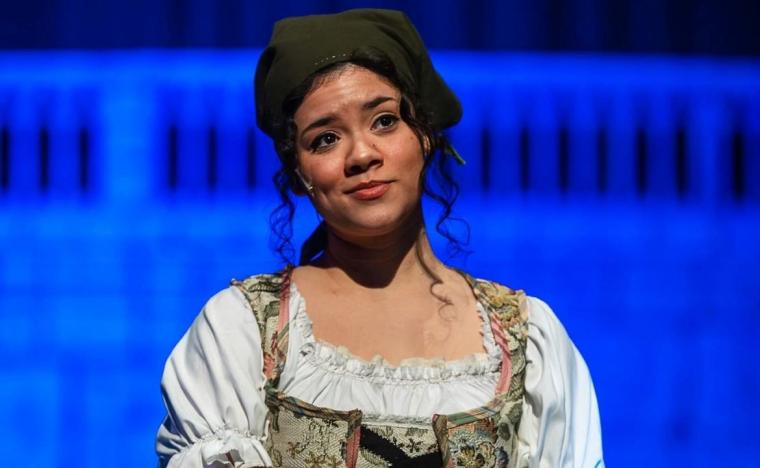
Ella and her stepfamily meet Jean-Michel (Jeremiah Viscioni), a fledgling revolutionary who is outraged that the people are suffering. The instigator is duplicitous palace advisor Sebastian (Dallas Foss), who’s hiding his machinations from the prince (Charles Murphy), called “Topher” for some reason instead of the French-ier “Christophe.” But then, he also has 11 other Pan-European names to choose from, as Lord Pinkleton (Eli Swailes) elucidates in his melodious “The Prince Is Giving a Ball.” Why? Topher must have a queen, and complains he doesn’t know any “girls,” as they, of course, were excluded from formal education. However, this Cinderella doesn’t address gender equality, but rather economic injustice. Greim's intrepid ensemble of 30, many of them stage veterans, play townspeople, knights, pages, courtiers, ball guests, and rural critters. That’s not only a lot of work for them, but also a lot of costumes, provided by Heather Blair.
Beane’s script is a genially messy scrapbook of oddments. He borrowed Cinderella’s “carrying-the stepsisters’-packages” and “offering-the-prince-water” bits from previous versions of the R&H mythos, and apparently copied-and-pasted the young rabble-rouser from Les Misérables, or maybe Fiddler on the Roof. A wacky chase scene stalled the action for I know not what – usually it’s for costume or scenery changes, but that didn’t appear to be the case here. The trying-on-the-slipper business is deferred until after a second kingdom-wide bash, requiring Marie to conjure another spectacular gown for Ella. Book writer Beane ingeniously explains the origin of the glass slippers, but awkwardly shoehorns in (see what I did there?) Jean-Michel’s gift of a book to Ella, which, just as magically as mouse-to-horse, transforms a monarchy into a democracy. Bibbidi-bobbidi-huh?
But really, plot be darned. All those songs! All these singers! In particular, Jensen's and Murphy’s voices are emotional and spectacular; “In My Own Little Corner,” “Ten Minutes Ago," “A Lovely Night,” and “Loneliness of Evening” are particular standouts. Beane gets my applause for turning “Stepsisters’ Lament,” which Hammerstein wrote for two, into “Stepsister’s Lament” – yep, only Charlotte, backed by the ladies of the court, as they seethe over the dainty beauty who’s captivated Topher. Fischer, with her perfect line readings and slapstick, leads the charge for Carpenter’s and Call’s transformation into a hilarious and surprisingly delightful stage family.
Large, practical elements of the script are executed with flair – one wheeled, load-bearing horse; four dainty, princess-worthy fantasy horses; a coach with pumpkin spice; and a puppet/costume hybrid depicting a giant, menacing, skeletal creature that Topher and his knights slay. No credit is given for these creations, or who portrayed and operated the monster, but I’m guessing that costumer Blair and set crew Sara Wegener, Dana LisenBee, and Ted Brown contributed. A path of painted cobblestones extends the playing area through the house-level seating, with a circular platform the perfect place for romantic duets and waltzes. Speaking of music, the recorded orchestration was pleasingly sprightly. And other than a couple of brief, minor feedback boofs, the sound was impeccable – well balanced, with every word understandable. Bravo!
With Rodgers & Hammerstein's Cinderella, the Spotlight has given us yet another gift of a large-scale musical, executed with care and brought to life by energetic, artistic experts who just happen to be our friends and neighbors. Enjoy the magic.
Rodgers & Hammerstein's Cinderella runs at the Spotlight Theatre (1800 Seventh Avenue, Moline IL) through December 14, and more information and tickets are available by calling (309)912-7647 and visiting TheSpotlightTheatreQC.com.