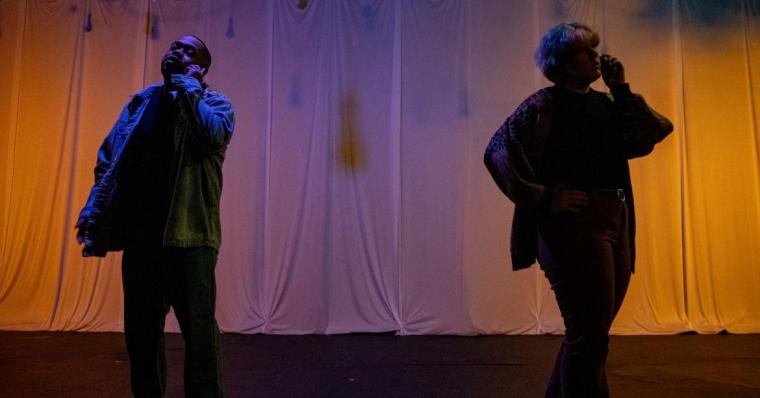
Keenen Wilson and Sera Calhoun in word play
What do you get when four young adults’ lives are entangled with one another, yet the full picture doesn’t come into focus until the final moments? You get word play, written by fellow Reader reviewer Alexander Richardson: a tightly woven one-act that asks its audience to lean in, listen closely, and trust the unraveling. Directed by Emma Wahlmann, Thursday’s opening night felt less like a simple production and more like an artistic vision come to life.
There is no scenic designer credited for this show, which makes sense, as aside from two chairs and swags of white fabric serving as a backdrop, the stage is bare. I readily admit I am a fan of a stripped-down playing space that allows words and actions to carry the story. It’s not uncommon to see theatres build magnificent sets yet struggle to back them up with equally magnificent performances. Luckily for all of us, Wahlmann’s cast does not struggle. This ensemble proves that minimalism only works when the talent is strong enough to fill the space, and here, it unquestionably is.
Richardson withholds even the comfort of full character names, offering only initials. Yet in this case, names feel beside the point. Identity is fluid here, shaped by circumstance and connection rather than labels. It feels unfair to separate Keenen Wilson, Shyan DeVoss, Evan Gagliardo, and Sera Calhoun, because the production depends so heavily on their interplay. Each actor spends the evening paired off in various combinations, navigating scenes of love, happenstance, miscommunication, and alcohol-fueled decisions. Watching them connect, sometimes tenderly, sometimes awkwardly, and sometimes painfully, offers a layered glimpse into the fragile architecture of young adulthood.
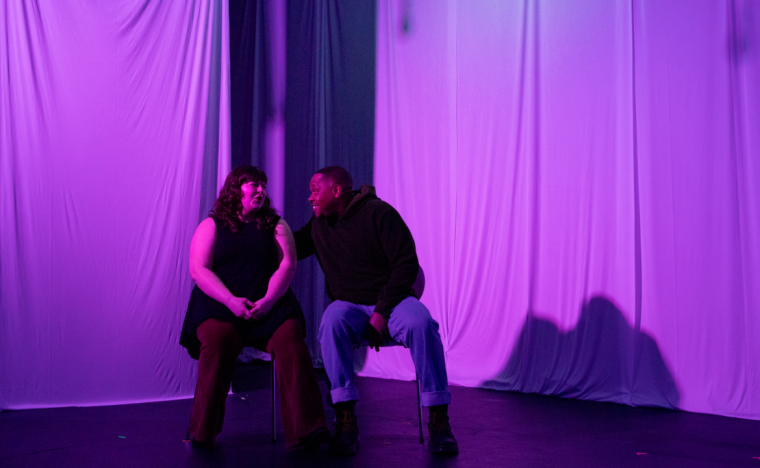
word play was especially interesting given that there was no predictable ending, nor much to guide your ability to figure out quite where the story would eventually end up. While I would like to single out one pairing as the evening’s emotional anchor, doing so would diminish the production’s structure. The interchanging scenes blend seamlessly, each moment refracting the others. Every performer demonstrates emotional depth alongside sharp comedic timing. Humor lands easily, but it never undercuts the flashes of hurt and vulnerability that ripple just beneath the surface. Just when I thought one person stood out, another would swoop in and quite literally steal their light.
Visually, word play experiments in a way I have not encountered before. Bare LED bulbs hang at varied intervals above the stage, exposed and unapologetic. Like many modern smart bulbs, they had the ability to shift colors throughout the performance, bright white and warm amber dominating quieter moments, while blue, pink, and green wash the stage in occasional spotty undertones. I appreciated how the colors ebbed and flowed with the action, subtly reinforcing mood. At times, however, the movement and shifts became slightly distracting, pulling focus from the dialogue.
The lighting design works in tandem with Richardson’s carefully curated soundtrack and originally composed music, which underscore every scene and emotional moment. Often, these pairings are beautiful. Romantic exchanges are cushioned by soothing tones; quieter confessions are buoyed by gentle melodies. The sounds of city streets become almost a symphony that could lull one to sleep.
In the final scene, however, the sound crescendos into a shrill, almost Psycho-like repetition, a deliberate and predictable pattern to build tension. The house lights pulsed in tandem, heightening the sensory effect. While the lights were not flashing quickly enough to warrant a formal warning in the program, the combined effect was not for the faint of heart. For this viewer, it seemed to stretch on much longer than necessary and had me longing for the actors to speed up the onstage action just so we could all move on from the frankly annoying and distracting technical elements.
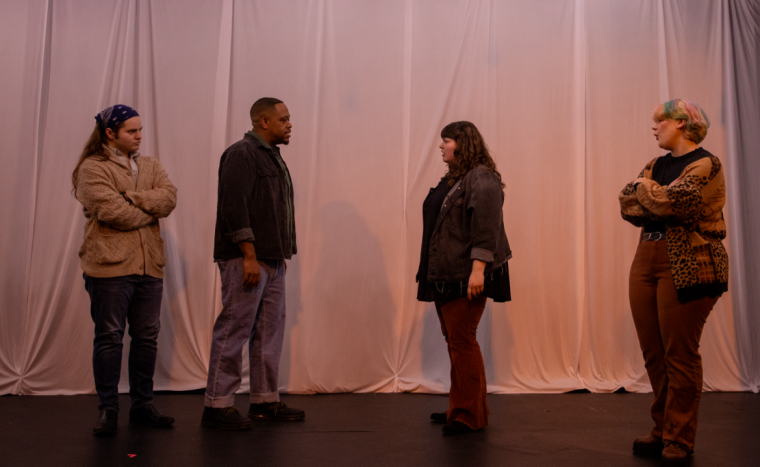
Meanwhile, what makes word play particularly compelling is the paradox at its core: Everything is happening to these characters, and yet nothing is. Their conflicts feel seismic in the moment – devastating, intoxicating, life-altering even. Yet as the structure reveals itself, we are reminded how quickly the monumental can shrink from memory. It’s a quiet but resonant commentary on modern emotional life. What consumes us today may barely register mere weeks from now.
And yet, Richardson wisely threads levity throughout. My personal favorite line involved Carol and her notoriously weighty casserole – a wisecrack I won’t spoil here. The humor is sharp but grounded, with characters equally willing to poke fun at themselves as to one another. Beneath the wordplay and wit lies a recognizable truth.
In the end, word play demands trust from its audience. It asks us to sit in ambiguity, to assemble the fragments, and to accept that clarity may arrive only at the last possible moment (or truly never at all). If you’re willing to lean into the uncertainty and the potential for vexing tech, in Wahlmann’s capable hands and with a cast fully committed to the emotional terrain, that trust is rewarded.
Barely There Theatre's word play runs at the Black Box Theatre (1623 Fifth Avenue, Moline IL) through February 28, and more information and tickets are available by visiting Facebook.com/BarelyThereTheatreQC.