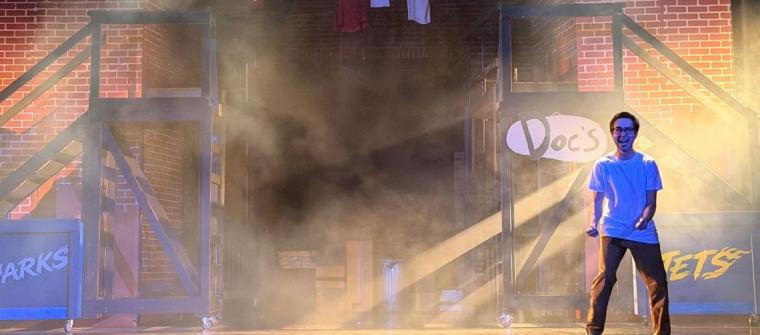
Casey Scott in West Side Story
In 1949, already-legendary choreographer Jerome Robbins envisioned a modern Big Apple retelling of Shakespeare’s Romeo & Juliet called East Side Story, about opposing Jewish and Irish-Catholic families. Composer Leonard Bernstein and librettist Arthur Laurents were on board.
Then someone realized the 1920s Broadway smash Abie’s Irish Rose used that premise. The project died. In 1955, when Laurents read about warring white and Puerto Rican street gangs, the collaborators reunited. He brought in novice lyricist Stephen Sondheim, and West Side Story debuted on Broadway in 1957, winning two Tonys. The 1961 film won 10 Oscars, and its Grammy-winning soundtrack spent more than a year at number one on the Billboard chart; its record in that category still stands. (It also landed in the Briggs household, becoming my first exposure to musical theatre.)
The current Spotlight Theatre offering of West Side Story boasts a gifted cast of 31. With director Adam Sanders, music director Christine Rogers, choreographer Bethany Sanders, and the rest of the team, the hard work and dedication of all is evident. This musical began with a dancer, and lives or dies by that art form. Sanders' production has some of the most intricate, varied, prolonged, high-density, high-energy choreography I’ve yet seen. Imagining the hours of rehearsal for this aspect of the show alone has me gasping. Just memorizing it is a feat – and then, they have to perform it! Add the singing, acting, costumes, set, and more … . It’s an ambitious production for community theatre.
Happily, Sanders' performers have considerable experience in theatre, opera, and dance, on Quad-Cities stages and beyond. Six of them also performed in the Spotlight's terrific cheer-competition musical Bring It On last June, and two were in Countryside Community Theatre’s fabulous Hairspray last July – both of which employed themes of dance and racial conflict, as does West Side Story.
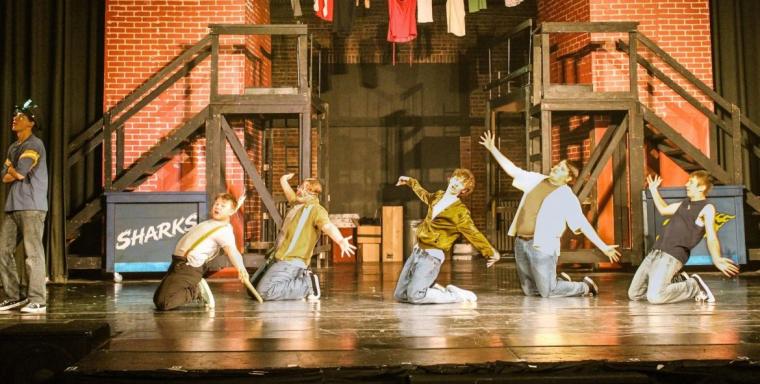
Casey Scott as Tony, Charleigh Weatherspoon as Maria, and Catie Johnson as Anita have excellent, strong singing voices. Weatherspoon blew the roof off the North Scott High School Fine Arts Auditorium with her potent vocals as Little Inez in Countryside Community Theare's Hairspray, and here, she proves she can handle, with innocence and sweetness, the extremely high register the role of Maria requires. Scott hits his high notes with aplomb, as well.
The Shark-side ladies dance and sing with zest in “America,” and Abi Jensen's Rosalia squares up boldly and amusingly with Anita as they throw insults at one another about their homeland and new home. On the other side, the Jets’ most volatile member is Action, played by the fierce and nimble Will Emerle. Both gangs – the Sharks, led by Bernardo (Jeremiah Viscioni), and the Jets, led by Riff (Jack Bevans) – personify capital-T Threats. They talk tough, dance tough, jump, catcall, shout, sing, and fight like wildcats.
In fact, the Jets (minus Tony, who is in hiding) enact the most upsetting moments of the show for me, an Act II number coyly named “The Taunting Scene” in the libretto and program. There’s no scripted dialogue. Instead, Bernstein’s music underscores the Jets’ deluge of improvised insults and choreographed physical abuse of Anita. It turns into what some writers call “simulated” or “threatened” sexual assault. It’s actually attempted sexual assault, stopped only because an adult intervenes. It was represented by a vaguely threatening dance in the original Broadway production, an overtly threatening dance in the 1961 film, and a realistic, frightening attack, sans dancing, in the 2021 film. In that rendition, the adult who saves Anita is a new character played by Rita Moreno – the original film's Anita. In the Spotlight's version, there’s nothing explicit about the scene, but actions and screamed slurs make the aggression obvious. Anita is a woman, and she’s brown, so some people instinctively hate her. This is what the show is about.
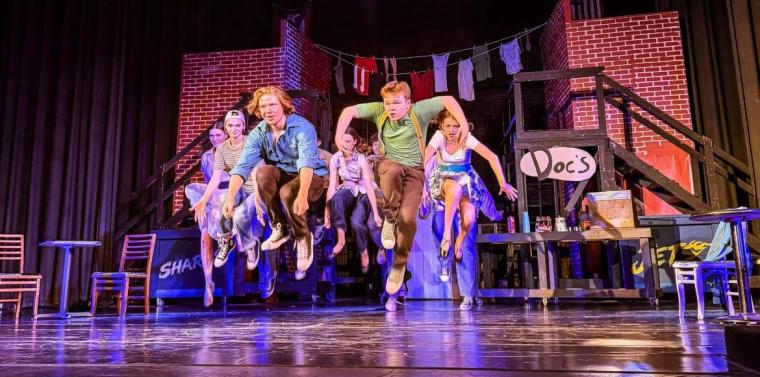
Most of Act II was surprising to me. First, I was happily confused by an extended ballet and song sequence, present in the original script, depicting a fantasy world in which all coexist peacefully. Both gangs' members dancing together wearing calm colors is a poignant sight. “Somewhere” is sung by an offstage voice as Tony and Maria dance. The company joins in. Then, the idyll turns into a hellish nightmare in which the deadly violence of Act I is revisited. The transition is depressingly effective. These scenes were not in either film, and the first stage version I saw cut it, as well. Secondly, it was unexpected that three numbers were performed in Act II as scripted for the stage show, not earlier, as in the movies. Another unexpected delight was a lovely new original moment for Addie Kuffler's supporting character Anybodys.
Technical issues on Friday's opening night were few. The persistent sound problems, though, consisted of mics cutting out frequently, and I was disappointed to note that a pair of nice turrets flanking the stage – presumably lookout points – were only used sporadically. However, the whole of the Spotlight's West Side Story really is a treat thanks to the dedication of a lot of folks. If you know the film as well as I do, just prepare to adjust your expectations.
West Side Story runs at the Spotlight Theatre (1800 Seventh Avenue, Moline IL) through June 21, and more information and tickets are available by calling (309)912-7647 and visiting TheSpotlightTheatreQC.com.