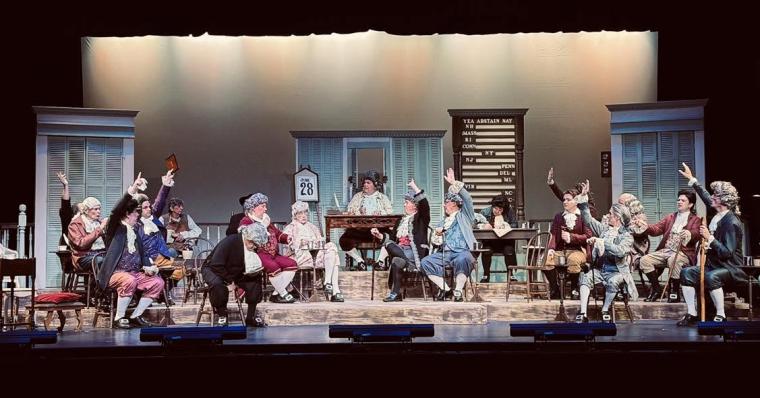
ensemble members in 1776
Two score and 17 years ago, a musical about America’s birth opened on Broadway: 1776, conceived by former history teacher and pop composer Sherman Edwards because, reportedly, he got tired of writing songs for Elvis.
It took more than a decade to finish, and with scriptwriter Peter Stone enlisted for the book, the show was a massive hit, winning three Tonys including Best Musical, and showcasing the musical-theatre skills of the man who co-wrote “Wonderful, Wonderful” and “See You in September.” Although the 1972 movie adaptation was a massive bomb, live theatre brings magic to the psyche that even today’s dual-4K laser projection, Dolby Atmos surround-sound, and a giant bucket of popcorn can’t muster. That magic is on display in Quad City Music Guild's and director Kathryn Weber's current, spirited presentation of 1776, its music direction by Claire Schaecher and choreography by Beth Marsoun. (And I hear the intermission hot dogs are terrific.)
At the beginning of Weber's production, which is well-paced and funny with serious moments, central character John Adams (the riveting, ever-energetic Matthew Call) explodes in frustration with his fellow delegates in the second Continental Congress, who’ve been meeting for a year. While Adams wants independence from British rule, some are against it. He gets Ben Franklin (an engaging, comical Bob Manasco) on his side, who recruits Richard Henry Lee (an enthusiastic, high-stepping Kevin Pieper) as a strategy to win over Southern colonies with the proposal. However, Lee bursts into a rah-rah hoedown/praise song about his influential family, “The Lees of Old Virginia,” and promptly leaves for home. Yet Adams and Franklin find another ally in Thomas Jefferson (Thayne Lamb, appropriately subdued). All of them also find more to argue about.
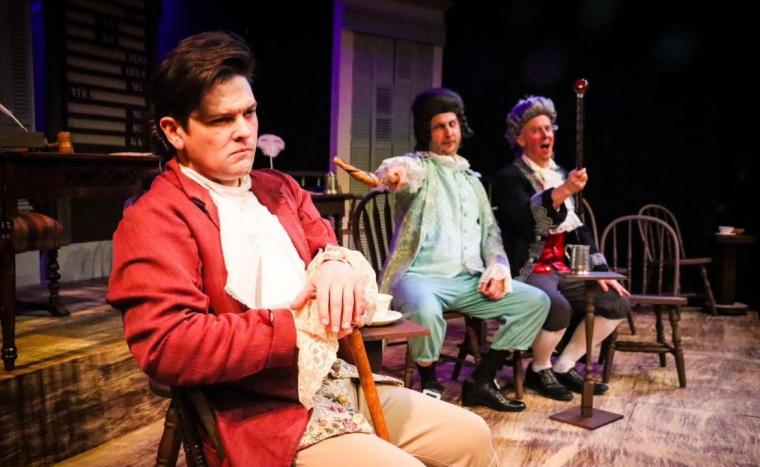
But how could there not be dissension among delegates from 13 colonies, enacted here by 20-some capitally talented, seasoned performers? (Their real-life number was 56 or so, and as in any adaptation, dramatic license allows characters and events to be dropped, consolidated, or straight-up made up.) The actors sell the misery of an 87-degree Philadelphia summer indoors: mopping brows, fanning, drooping in their seats. But when they open the windows, flies enter, dramatized by the swatter-wielding John Hancock (an imposing Michael VanBelle), with subtle buzzing provided by sound designer Miranda Richards. So it’s either perspire or whack bugs. The forefathers dressed in snug layers – most having traveled hundreds of miles from home by stagecoach, horse, or schooner, some suffering from incurable ailments – held our future in their sweaty hands. And like contending with the heat, the actions they take come with downsides. They have to weigh each decision against its effects on everyone, from overseas powers to the delegates next to them to the lowliest British subjects (as they all were, pre-independence).
Some residents were seen as even less than lowly. Mighty-voiced Brent Behrens, as South Carolina’s Edward Rutledge, points out in “Molasses to Rum” that the Northerners sneering at slave-owning Southerners are profiting from the sale of abducted Africans. An ultimately eliminated anti-slavery clause in the Declaration of Independence acknowledged that Black people were humans, though opponents considered them property. To the Continental Congress, Native Americans didn’t even exist. And women were not people, not even an afterthought – in the Declaration of Independence, after all, Jefferson wrote “all men are created equal.”
Women are useful for taking care of family and business and . . . other things. Rachel Vickers, as John’s most influential advisor Abigail Adams, unleashes her gorgeous, powerful voice in three numbers, demonstrating acting skills to match. Hillary Erb portrays Martha Jefferson as a seductive distraction for her politically traumatized husband, and is delightfully sprightly and melodious describing his wooing to Adams and Franklin in “He Plays the Violin.” (Later, be sure to check out gout-stricken Franklin leaping from his chair when “whoring and drinking” are in the offing.) And what of the impoverished young militiamen who actually fought the British? 1776’s creators gave them a somber moment of acknowledgment. A nameless young courier in a dusty coat (Michael Kelley) re-enacts the battle death of his best friend in the moving “Momma, Look Sharp.”
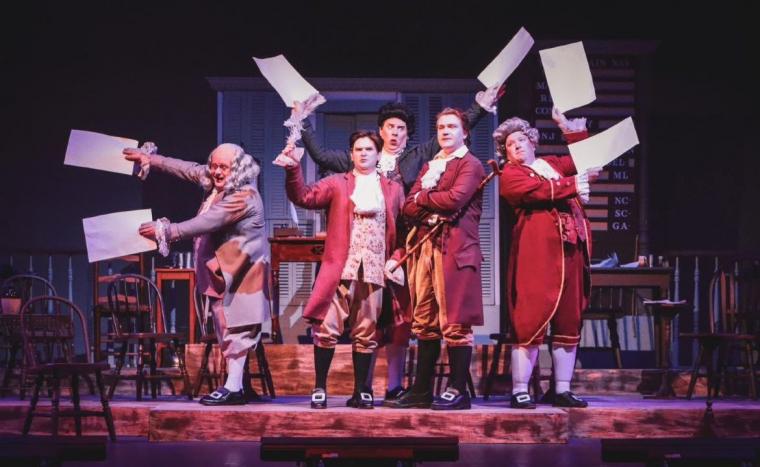
Back to the mature white guys. Finely dressed conservatives mildly mock their own privilege in “Cool, Cool Considerate Men,” with Marsoun's simple, effective choreography punctuated by canes and walking sticks – essential men’s accessories of the time. So also sing “Hosanna” to Sheri Olson and her props crew; costume designer Julia Jackson, who manages a large, gratifyingly colorful wardrobe; makeup artist Sue Cates; and an unnamed wig wrangler (another big job).
No records were kept of the Continental Congress, so Edwards and Stone relied on memoirs and imagination. As did 1776’s biggest fan Lin-Manuel Miranda when he composed Revolutionary-era political intrigue: “No one else was in the room where it happened.” This show, too, though modified for modern audiences, is a toe-tapping history lesson.
Unfortunately, at Thursday’s preview performance, the 17-piece orchestra routinely overpowered some singers. I'm crossing fingers that the issue has been fixed, because 1776 is a professional, tuneful good time that’ll make you proud of Congress again. Happy Independence Day.
Quad City Music Guild's 1776 runs at the Prospect Park Auditorium (1584 34th Avenue, Moline IL) through June 21, and more information and tickets are available by calling (309)762-6610 and visiting QCMusicGuild.com.