
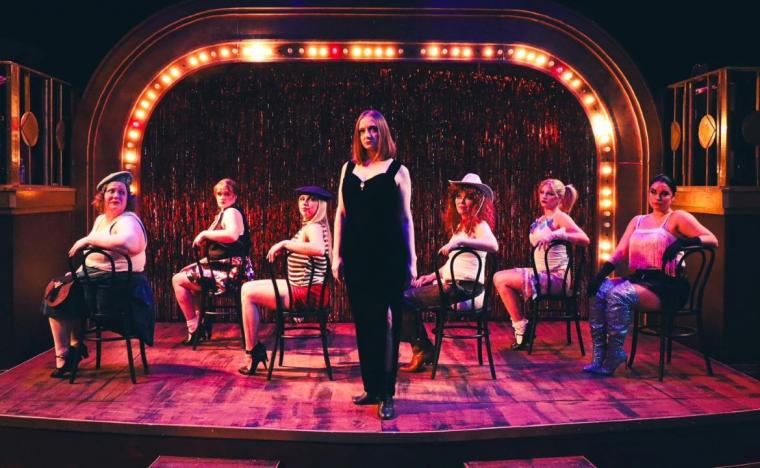
Stephanie Moeller and members of the Cabaret ensemble
The 1966 stage smash Cabaret, with its music by John Kander, lyrics by Fred Ebb, and book by Joe Masteroff, had as its source material 1945’s The Berlin Stories, a collection of semi-autobiographical writings by Christopher Isherwood, adapted to play form in 1951. Cabaret was the second musical incarnation of that play, and collected eight Tonys including Best Musical. The 1972 film adaptation, slightly shifted in plot and tone, won eight Oscars. Some songs were cut and others added, which subsequently became part of the stage libretto. It’s also Quad City Music Guild’s current production, which I saw at the Thursday preview.
This musical was both wildly popular and scandalous for its time. Some consider the material disgraceful still – hence the content warning announcement before this production. So beware … if blink-and-you’ll-miss-it mimed drug use and boys kissing boys shock you. Director Luke Vermeire and assistant director Adrienne Evans, both accomplished actors as well as auteurs, have assembled a wide array of exceptional talent to create this sleek production. But don’t come expecting to leave your troubles outside, as Cabaret’s Emcee urges. Don’t get me wrong: It's an excellent production. But I left the theatre utterly shattered, as the creators, and this company, intended. There are horrors far worse than same-sex relations.
The action takes place in early 1930s Berlin, mostly in the Kit Kat Klub, a shabby incarnation of the city’s notorious nightlife. A few bulbs in its marquee lights are missing, just as are our real-life theatre’s marquee lights (intentionally). The supposed second-rate talents on the fictional stage, however, are actually top-notch Quad Cities performers. Stephanie Moeller plays English entertainer Sally Bowles, immersed in her own pleasures like most of the club-goers – but she’s only jaded on the surface. Inside, she’s as lost and rootless as Blanche DuBois. I’ve long admired Moeller’s acting prowess on stage, but hadn’t heard her powerful, emotive singing voice until now. And wow, she’s sublime as the bubbly yet desperate Sally, sporting a natural-sounding English accent, to boot.
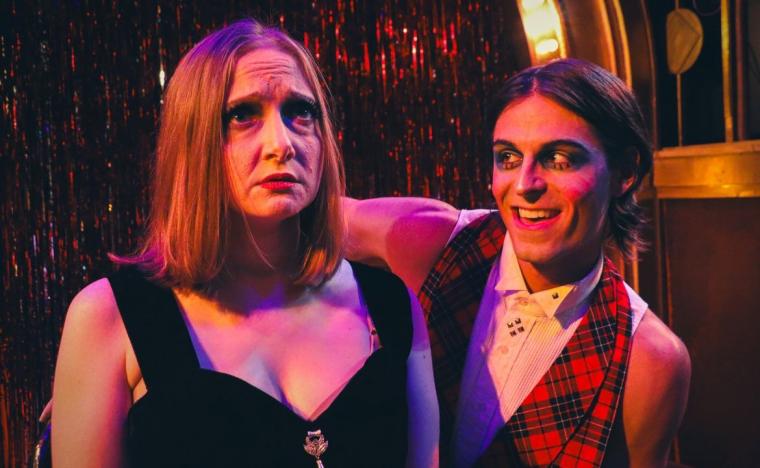
She encounters Cliff, a tourist at the club, and subsequently moves into his boarding-house room. The multi-talented Daniel Williams is absorbing as the multifaceted American writer without inspiration, a sunny smile usually cloaking his worries. He’s game to partake in the general hedonistic revelry, but becomes increasingly aware of the societal tide turning.
The Klub’s Emcee, portrayed with wonderfully diverse energies by John Whitson, is more than a master of ceremonies. Usually brimming with enthusiasm and glee, he’s sometimes jaded, with a touch of menace. Is he a clown? A mirror? Merely a color commentator, or an instigator? An Everyperson? Fate? A trickster god, like Loki or Anansi? The big-G God? Satan? I still don’t know. But I do know that, as well as triumphing in this demanding role, Whitson is impressively jacked.
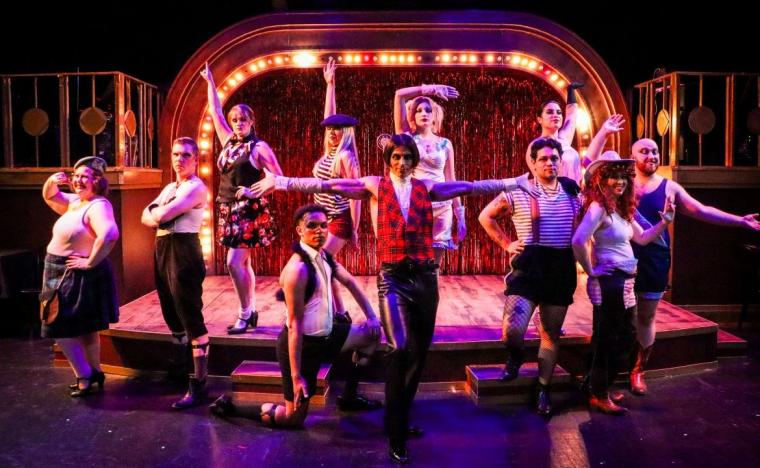
The strong supporting cast, fantastic singers all, includes Drew DeKeyrel as Ernst Ludwig, a Berliner whom Cliff befriends; Valeree Pieper as Cliff’s landlady Fräulein Schneider; Kevin Pieper as her suitor Herr Schultz; and Madison Duling as Fräulein Kost, who entertains many suitors. The members of the Kit Kat Klub Girls and Boys ensemble, all talented and energetic, are led by choreographer Kim Munn. Their supposed nationalities, indicated by stage names and costumes, include Germany, France, England, and America. They could be expats who decided to stay, like Sally, but they evoke major players in the coming global conflict, as does the musical’s opening line, “Wilkommen, bienvenue, welcome.”
The pastoral tune and nationalistic refrain “Tomorrow Belongs to Me,” rather than being sung by an innocent blond lad as usual, is presented by a young-sounding voice, broadcast over a staticky radio. It will be reprised by the company, and played repeatedly at intermission by the marvelous orchestra of 11 musicians. Applause to them, as well as music director Matthew Reece and assistant music director Mitch Carter.
So why is this show particularly unsettling now, 60 years later? Hands are thrown, but nobody dies. Comical, exaggerated thrusting with no contact on a nightclub stage suggests sex, but there’s no overtly sexual action. Kisses are simulated, with one character’s head always obscuring both faces. The one actual center-stage kiss was tentative, close-lipped, and, in this production, between actors married to one another. Cabaret is upsetting because we, the audience, know what all this was building toward – then, and now. Berlin will be the capital of the Third Reich. World War II is imminent. About 80 million will die. Not just lives and families will lie in ruins, but cities; entire countries. The show’s finale is well-done, and particularly devastating.
One of the prime directives of community theatre is to not alienate audiences, because that means potentially losing them, perhaps forever. During Cabaret’s first run on Broadway, people walked out of the theatre because they were offended by the sexual overtones. That imagined threat often gets undue attention and outrage. But, just as in Cabaret, it’s a mere distraction from the very real, deadly danger of insidious fascism.
Quad City Music Guild's Cabaret runs at the Prospect Park Auditorium (1584 34th Avenue, Moline IL) through April 19, and more information and tickets are available by calling (309)762-6610 and visiting QCMusicGuild.com.