

It's commonly understood that not all great movies are necessarily great-time movies, and I think we can all agree that not all great-time movies are necessarily "great." (Formally brilliant and historically essential though they are, I'm not sure I could summon the energy to sit through Intolerance or Triumph of the Will again, and while I love Harold & Kumar Go to White Castle to death, you'll never read 2,000 words on it in Cahiers du cinéma.)
 At first, I thought it might be fun to compose 200-ish words each on my 10 least-favorite 2008 movies, to go along with my 10 favorites for the year. And then I realized that would just be mean-spirited and silly. And I still opted against it.
 So you've got my 10 favorite movies and 20 least-favorite movies for 2008 ... but what about the 139 that landed somewhere in between?
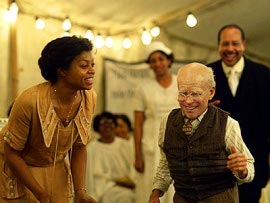 THE CURIOUS CASE OF BENJAMIN BUTTON
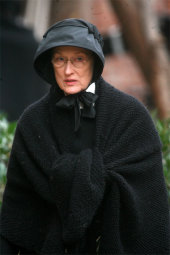 DOUBT
DOUBT Did you know there are Reader readers who don't know that the What's Happenin' pages can also be found online? Just thought I'd mention it.
 I love David Sedaris' writing, but on those rare occasions when I've heard the author read from his works on National Public Radio, I can only listen to him for a few minutes before feeling compelled to change the station. It's not that his high, reedy voice is unpleasant, exactly. But the caustic self-deprecation and derision that can make his stories so wickedly funny strike me as whiny and ungainly when Sedaris himself vocalizes them, and when he indulges in sentiment, his attempts at honest emotion ring hollow. (His "heartfelt" moments don't sound noticeably different from his sardonic diatribes.) This isn't a huge failing - Sedaris, after all, is a writer, not a performer - yet I still find that a little of him, vocally, goes a long way.
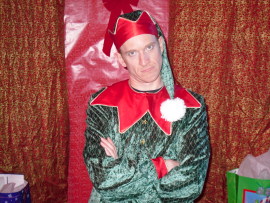
 "Happy
Holidays, Jeff!"
"Happy
Holidays, Jeff!"
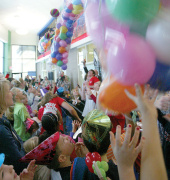 Strange
as it may seem, there are some people who would love to ring in the
new year with a festive party who can't quite manage to stay awake
until midnight. But enough about me. If you'd like to celebrate the
arrival of 2009 with your kids, yet are concerned about them (or
perhaps you)
nodding off before the ball drops, Bettendorf will be offering a
sensible December 31 alternative - the shouting of "Happy New
Year!" at 12 p.m.
- at two of the city's family venues.
Strange
as it may seem, there are some people who would love to ring in the
new year with a festive party who can't quite manage to stay awake
until midnight. But enough about me. If you'd like to celebrate the
arrival of 2009 with your kids, yet are concerned about them (or
perhaps you)
nodding off before the ball drops, Bettendorf will be offering a
sensible December 31 alternative - the shouting of "Happy New
Year!" at 12 p.m.
- at two of the city's family venues.
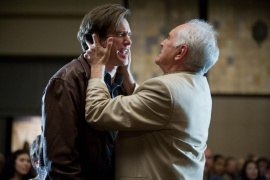 YES MAN